

CAE Crash Analysis: Driving Innovation in Vehicle Safety and Crash Testing
CAE crash analysis utilises system simulations & numerical methods, such as Finite Element Analysis (FEA), to analyse how vehicles behave during a crash. The process starts with creating a CAD Model, then applying different conditions of crashes & running simulations to study potential failure points, structural deformation, and energy absorption. The engineers can optimise the efficiency & design before conducting the physical vehicle crash testing.
Why is CAE important in Crash Analysis?
- Enhances Safety – Allows engineers to refine seatbelts, airbags, & vehicle structures for better passenger protection.
- Saves Time and Cost – Reduces reliance on expensive and time-consuming physical crash tests through efficient virtual simulations.
CAE also improves design by enabling lighter vehicles without compromising safety & it ensures global safety standards and regulations.
Advantages of CAE Crash Analysis include:-
- Lower costs than repeated physical car crash testing.
- Shorter development cycles.
- Safer and more optimised designs.
- High accuracy in predicting crash test ratings.
How CAE Crash Analysis Works?
- Preprocessing – Import the car’s CAD design, convert it into a mesh, and define material properties for a realistic crash simulation.
- Boundary Conditions – Set crash test speed, direction, and collision parameters.
- Analysis Setup – Choose solver types like explicit dynamics for high-speed impacts.
- Simulation – Run the crash analysis system; depending on complexity, this can take hours or even days.
- Post-Processing – Review crash data analysis, including force, deformation, and occupant injury predictions, then refine the design.
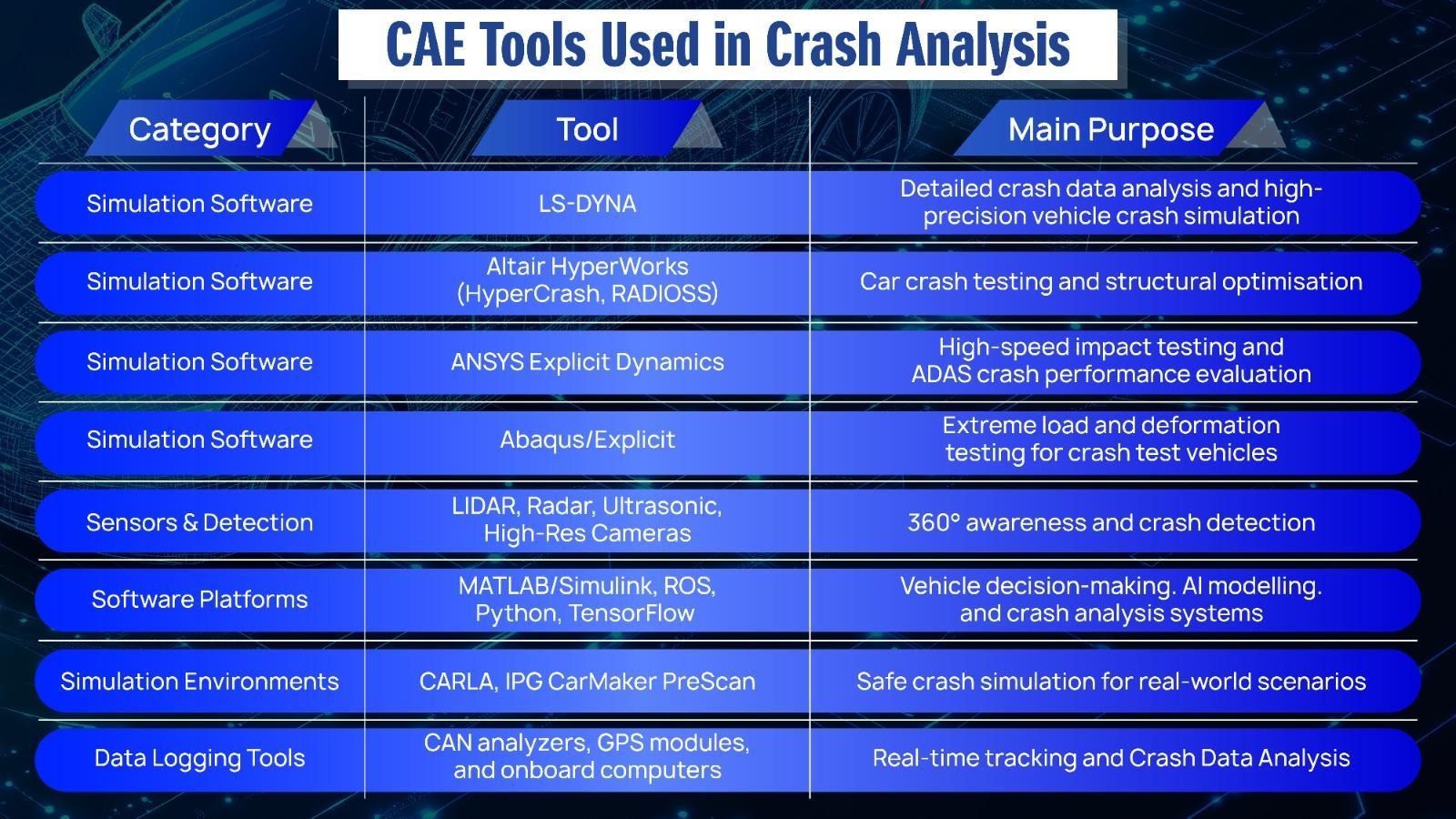
CAE Tools Used in Crash Analysis
Vehicle Behaviour in Emergencies & Fault Attribution
One of CAE’s strengths is modelling split-second scenarios, like a swerving vehicle or a pedestrian suddenly crossing. Safety systems react in milliseconds, adjusting braking, steering, or airbag deployment to reduce injury risk.
Crash testing also helps assign fault, whether it’s a design flaw, sensor error, or driver behaviour. At SRDI, multi-speed testing ensures vehicles respond appropriately at different crash test speeds, while human-aware alerts provide real-time warnings to both drivers and pedestrians.
Common contributing factors:
- Sensor limitations in bad weather
- Poor road markings or signage
- Driver errors like tailgating or unsafe speeds
Types of Crash Tests Simulated
- Frontal Impact – Direct head-on collision.
- Side Impact – Hit from the side by another vehicle or object.
- Rear Impact – Collision from behind.
- Rollover – Vehicle flips due to an imbalance or sharp manoeuvring.
- Pedestrian Impact – Evaluates injury risk in pedestrian collisions.
- Oblique Impact – Crash at an angle.
These simulations also support self-driving car crash statistics research and autonomous vehicle crash data evaluation. At SRDI, multi-speed testing ensures vehicles respond appropriately at different crash test speeds, while human-aware alerts provide real-time warnings to both drivers and pedestrians.
Advanced Applications of CAE in Crash Analysis
When a crash test vehicle meets with an accident, the performance of safety features like airbags, seatbelts, and crumple zones determines how well passengers are protected. Before these features undergo car crash testing in real life, engineers use CAE (Computer-Aided Engineering) for crash simulation and crash analysis to evaluate their performance.
CAE enables the use of virtual crash testing to study how vehicles behave during collisions. This process reduces the need for multiple physical tests, lowering costs and saving time, while still working toward the best car crash test performance and improved crash test ratings.
- Multi-Physics Simulation – Integrates structural, aerodynamic, and thermal effects in crash simulation.
- Occupant Safety Optimisation – Improves seats, restraints, and ADAS crash performance.
- Material Modelling – Predicts how different materials behave during car crash testing.
- LIDAR and Crash Detection – Simulates advanced sensor-based systems for collision avoidance.
Limitations of CAE in Crash Analysis
- May not fully match real-world results.
- Complex to set up.
- Requires high computing power.
- Physical tests are still needed for validation.
Shaping the Future of Vehicle Safety Through CAE Crash Analysis
By integrating car crash testing, crash simulation, crash detection, and crash data analysis, Suzuki R&D India (SRDI) is able to deliver safer, more efficient vehicle designs with consistently higher crash test ratings.
Through continuous research, advanced crash analysis systems, and close collaboration with regulators and industry partners, SRDI is moving the automotive sector closer to achieving the best car crash test results, making roads safer for drivers, passengers, and pedestrians alike.
Advanced Methods in Crash Analysis
To handle challenges, engineers at SRDI India use:
- Finite Element Analysis (FEA) – Detailed stress and deformation mapping
- Multi-Body Dynamics (MBD) – Modelling moving safety components
- Material Modelling – Testing materials at different crash test speeds
Optimisation Algorithms – Finding the safest, most efficient designs
Collaboration & Policy Work
Technology alone can’t make roads safer; policies and testing standards must evolve, too. SRDI works with policymakers to:
- Develop better crash testing guidelines
- Improve crash analysis systems for all vehicle types
- Update traffic laws for modern safety technology
SRDI’s commitment to combining advanced CAE crash analysis with real-world testing is paving the way for safer, smarter, and more resilient vehicles on our roads.