

Advantages of Electric Cars: Cost, Environment & Economic Impact
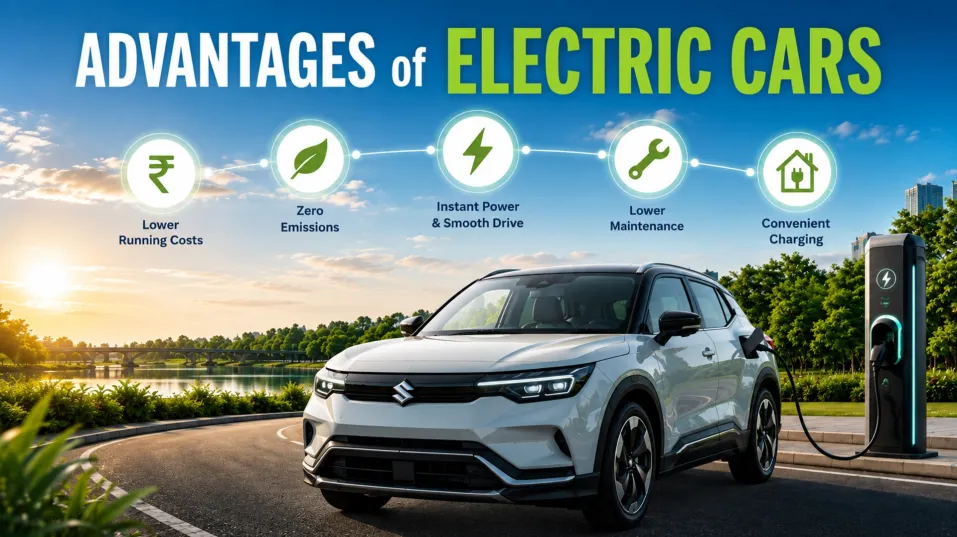
The advantages of electric cars (EVs) include producing no tailpipe emissions, helping to clean urban air, delivering instant & smooth acceleration, and reducing maintenance costs over time.
Electric cars are quiet & smooth to drive, and they give power instantly when you push the accelerator. You can also charge them at home, which makes daily use very easy. This makes electric cars a smart & practical choice for today’s drivers.
Electric Cars Advantages: Lower Running & Maintenance Costs
Fuel Savings
Electric cars are much more economical to run than petrol or diesel cars in India, saving you at least 3-5 times per km.
Lower Maintenance Bills
Electric cars are mechanically far simpler than internal combustion engine cars.
An EV drivetrain has a fraction of the moving parts. They do not have
- Pistons
- Crankshaft
- Complex multi-speed gearbox
- Exhaust system
- Engine oil circuit
Because of this simple structure, maintenance becomes much easier and more affordable. As a result:-
- No engine oil or oil filter changes required
- No timing belt or chain replacements
- No spark plug, fuel injector, or exhaust system servicing
- Regenerative braking reduces brake pad wear dramatically. This often extends pad life to two or three times that of a conventional vehicle
- Fewer fluid systems mean fewer fluid-related failures & replacements
For fleet operators & high-mileage users, this difference is even more pronounced and has been a primary driver of rapid fleet electrification across logistics, taxi, & delivery sectors in India.
Battery Longevity & Warranty Assurance
Modern EV batteries are engineered to last the practical life of the vehicle. In addition, advances in battery thermal management are extending battery health further. It is reducing one of the historically cited concerns about long-term EV ownership costs.
Advantages of electric cars to the environment
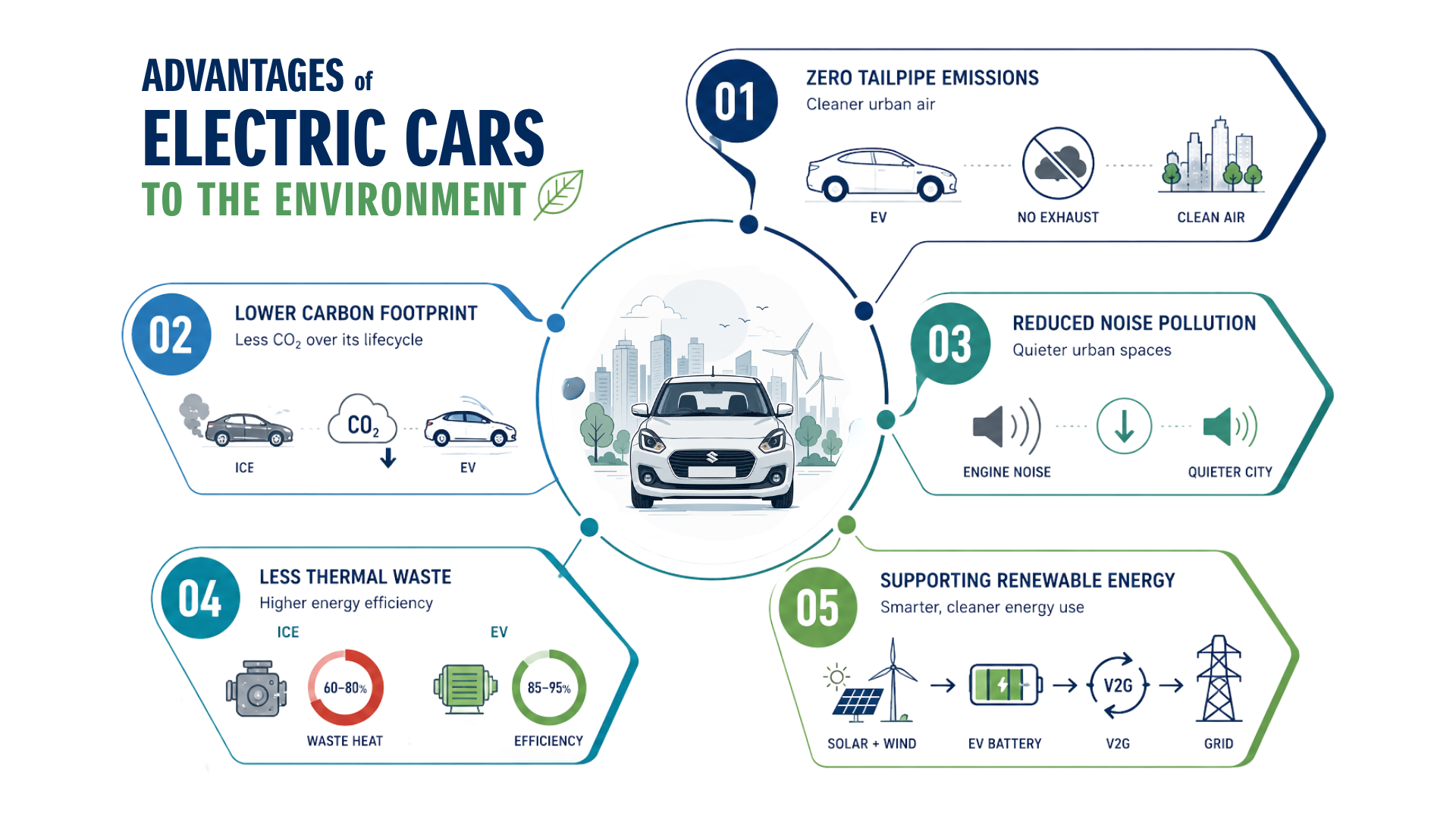
Zero Tailpipe Emissions in Urban Areas
The most immediate environmental benefit is the complete elimination of exhaust gases at the point of use.
The widespread EV adoption has the potential to improve urban air quality within just a few years of scaled deployment.
Lower Lifecycle Carbon Footprint
Even accounting for the energy used in manufacturing, including battery production & the current carbon intensity of India's electricity grid, EVs produce significantly less CO₂.
As India continues to add renewable capacity at scale, with solar & wind generation growing rapidly, this advantage compounds every year.
An EV purchased today will become progressively cleaner over its operating life without any change to the vehicle itself.
Reduced Noise Pollution
Electric motors operate nearly silently compared to combustion engines, particularly at low speeds where urban noise pollution is most disruptive.
The widespread adoption of EVs in cities contributes to measurably quieter urban environments, with documented positive effects on public health. This includes:-
- Reduced stress
- Improved sleep quality
- Lower rates of noise-induced cardiovascular strain.
Less Thermal Waste
ICE vehicles are highly inefficient in energy conversion terms. It releases 60–80% of the fuel's energy as waste heat into the environment.
This contribution will reduce the urban heat island effect that is modest at the individual level but meaningful at the scale of millions of vehicles in dense cities.
Supporting Renewable Energy Integration
As Vehicle-to-Grid (V2G) technology matures, EVs will increasingly serve as:-
- Distributed energy storage
- Charging when renewable generation is surplus
- Potentially supply electricity back to the grid during peak demand.
This positions EVs as cleaner transport & active components of a smarter, more resilient national energy system.
Economic Impacts of Electric Cars
For Individual Owners
Beyond the running cost savings already discussed, EV owners in India benefit from a favourable & improving policy environment.
An individual can also get state-level incentives. This includes:-
- Registration fee waivers
- Road tax exemptions
- Direct purchase subsidies under various state EV policies.
It further reduces the effective ownership cost in many parts of the country.
The total cost of ownership calculation, when these factors are properly accounted for alongside lower fuel & maintenance costs. This increasingly shows EVs to be financially competitive with or superior to petrol vehicles, even at current purchase prices & the gap is narrowing every year as battery costs continue to fall.
For the National Economy
India spends hundreds of billions of dollars annually on crude oil imports. This makes the country's economy highly sensitive to global oil price movements.
Accelerating EV adoption directly reduces:-
- Import dependency
- Conserving foreign exchange
- Improving the current account balance
- Insulating the broader economy from external energy price shocks.
The EV transition is also generating substantial domestic economic activity. Battery manufacturing, electric drivetrain development, charging infrastructure deployment, & software development for connected EVs are all creating high-value employment and building industrial capability within India.
The government's Production Linked Incentive (PLI) scheme for Advanced Chemistry Cell batteries is specifically designed to anchor battery manufacturing in India rather than relying on imports.
The Future of Electric Cars and Industry Growth
Global Market Growth
The International Energy Agency projects that EVs could make up over 60% of new car sales globally by 2030 under current policies.
This share could go even higher if governments take stronger steps towards reducing carbon emissions.
Battery costs have drastically fallen & is expected to fall further by 2030. This shows EVs are expected to reach purchase price parity with ICE vehicles without subsidies in most markets.
India's EV Ambitions
India has set a target of 30% electric vehicle penetration across all vehicle categories by 2030.
The Indian government's EV30@30 commitment is creating the conditions for accelerated mainstream adoption. For this, the government is:
- Rapidly expanding charging infrastructure
- Growing domestic battery manufacturing capacity
- Increasing model availability from both global & Indian manufacturers.
The two-wheeler and three-wheeler segments are already well on their way, & the passenger car segment is following closely behind.
Technological Evolution
The next decade will bring significant further advances in EV technology.
1. Solid-State Batteries
Currently in advanced development stages at several major manufacturers, it promises energy densities 2–3 times higher than current lithium-ion cells, faster charging, improved safety, & longer lifespans.
2. Faster Charging Infrastructure
With ultra-rapid chargers capable of adding 200+ km of range in under 15 minutes already being deployed, it will further erode the charging convenience gap with petrol refuelling.
3. Vehicle Intelligence
It will also deepen substantially. Autonomous driving features:-
- Sophisticated energy management systems
- Predictive maintenance
- Seamless Vehicle-to-Grid integration
This will make future EVs dramatically smarter than today's already capable models.