

ADAS Level 3: What is it and how does it work?
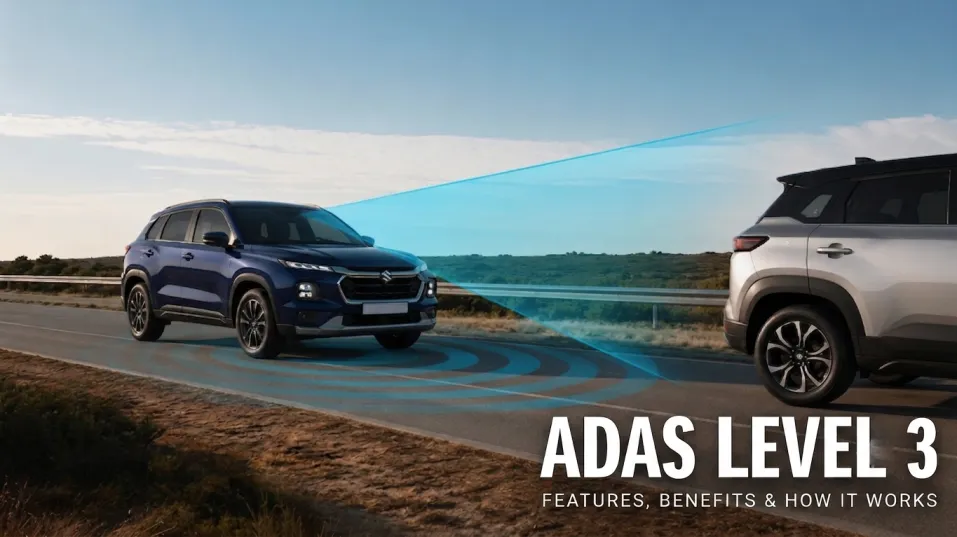
Ever wondered when cars truly drive themselves? While full self-driving cars (ADAS Level 4 & Level 5) are still being developed, ADAS Level 3 is the bridge between assisted driving and autonomous driving. It lets vehicles take over steering, braking, & acceleration whenever driving conditions are predictable, offering drivers a preview of autonomous driving while ensuring they remain in ultimate control.
What is ADAS Level 3?
ADAS Level 3, also known as Conditional Driving Automation, is the first real step into autonomous driving technology. Unlike ADAS Levels 1 & 2, where the driver must constantly monitor the system, Level 3 allows the driver to disengage from active control under certain conditions, like highway driving or traffic jams.
This makes Level 3 a milestone in the journey from driver-assist systems to fully autonomous vehicles.
From Assistance to Autonomy: Why ADAS Level 3 matters?
ADAS Level 3 is not just an upgrade to existing ADAS features; it represents a shift towards autonomous driving. By combining AI, LiDAR, radar, & cameras, ADAS Level 3 vehicles make independent decisions while still relying on the driver as a backup.
It prepares drivers, regulators, and road infrastructure for the future of autonomous driving in India & globally.
Benefits of ADAS Level 3 Automation
Reduced Driver Fatigue
Daily commutes and long highway journeys can be tiring! With ADAS Level 3 automation, drivers can take short breaks from active driving. This helps reduce stress, tiredness, and the chances of mistakes caused by fatigue.
Enhanced Road Safety
ADAS Level 3 systems are equipped with high-precision sensors and intelligent processing. They react faster than human drivers in many situations. This reduces the risk of accidents caused by distractions, delayed reaction time, or poor visibility.
Better Mobility for All
ADAS Level 3 automation offers more freedom to senior citizens, people with physical limitations, & those with less driving experience. They can travel independently and safely without needing constant help from others.
Improved Driving Comfort
Driving in stop-and-go traffic can be tiring! With Level ADAS 3 automation, the vehicle can handle such situations. It allows the driver to relax or focus on light tasks while the vehicle moves through slow traffic.
How Does ADAS Level 3 Work?
ADAS Level 3 is a semi-autonomous driving system where the vehicle can handle all driving tasks, such as steering, braking, and acceleration, under defined and specific conditions, such as on a highway and in traffic jams. However, the driver must stay alert and be ready to take control when the system prompts.
Key Characteristics of ADAS Level 3
1. Conditional Automation: The System Takes Control
In ADAS Level 3 automation, the vehicle can control multiple tasks:
- Steering
- Braking & acceleration
- Lane centering
- Monitoring nearby vehicles
- Managing stop-and-go traffic
This level of automation works well in environments where driving conditions are predictable. Some common situations include:
- Driving on highways with proper lane markings
- Low-speed traffic jams on expressways
- Smooth roads without complex turns or intersections
When these conditions are met, the driver can relax & perform other light activities, such as:
- Reading emails
- Watching videos
- Talking on the phone
However, the system is only reliable under these set conditions. If anything unusual occurs, the driver must step in.
2. Driver Intervention is Still Required
The system can drive the vehicle, but having the driver alert adds an extra layer of safety. The driver’s presence helps manage unexpected or changing road situations smoothly.
The vehicle may ask the driver to take control in situations like:
- Sudden weather changes, such as heavy rain, fog, or snow
- Poor road conditions, like construction zones or potholes
- Unexpected obstacles or accidents ahead
- Entering areas not covered by the system, such as complex city intersections
To alert the driver, the system uses:
- Sound alerts – like warning beeps
- Visual signals – such as messages or lights on the dashboard
If the driver doesn’t respond in time, the system takes emergency actions like:
- Slowing the vehicle down
- Turning on the hazard lights
- Bringing the vehicle to a safe & complete stop
These safety ADAS level 3 features ensure that the vehicle protects the passengers, even if the driver is not fully attentive at that moment.
3. Environmental Monitoring: The Vehicle’s Sensors
ADAS Level 3 systems use advanced technology to help the vehicle make smart driving decisions. The ADAS level 3 cars are equipped with a mix of hardware & software that constantly watches the road and everything around it.
Key components like LiDAR, Radar, Cameras, and Ultrasonic Sensors collect the data and transfer it to the ADAS level 3 car's central computer. It processes the data in real time. The system is designed to:
- Know where the vehicle is at all times
- Spot moving and still objects around the vehicle
- Predict how other vehicles or pedestrians might behave
- Make quick & safe driving decisions
This process is known as sensor fusion, where the vehicle combines data from all its sensors to build a complete 360-degree view of its surroundings. This allows the vehicle to drive safely & smoothly, even in challenging road conditions.
4. Eyes-Off Capability, But With Caution
One of the most noticeable Level 3 ADAS features is the ability for the driver to take their eyes off the road. This means you can:
- Watch a video on the infotainment screen
- Use your phone for calls or messages
- Relax during slow-moving traffic
However, this does not mean full freedom. The system still depends on you to be present and alert. The driver cannot:
- Sleep
- Leave the driver's seat
- Be under the influence of alcohol or medication
The vehicle assumes that the driver is ready to take back control at any time. This is why it’s called "conditional automation"; it only works when both the system and the driver cooperate.
ADAS Level 3 Features
AI (Artificial Intelligence) & Algorithms
AI & algorithms of Machine Learning are used to manage complex conditions of the road, analyse sensor data, & make informed decisions.
Traffic Jam Assist
Enables the car to drive itself in low-speed, high-density traffic, showcasing how autonomous driving can ease congestion stress & significantly reduce driver fatigue.
Handover Request Alerts
Notifies the driver through sound and visual cues when they must retake control, especially during unexpected or complex scenarios.
Fallback / Minimal Risk Manoeuvers
If the driver fails to respond, the autonomous vehicle performs emergency actions like decelerating, pulling over, or stopping safely.
High-Definition Map Integration
Integrates real-time HD map data with sensor input, enabling autonomous driving systems to understand & navigate complex road environments with greater accuracy.
Restricted Operational Design Domain (ODD)
The system functions only in approved scenarios, like specific highways or weather conditions, to ensure reliability & safety.
Lane Centring & Adaptive Cruise Control
Autonomously maintains lane position and a safe distance from surrounding vehicles, intelligently adjusting speed to reflect real-world traffic flow.
Automated Lane Change (in some vehicles)
When conditions permit, the vehicle can change lanes autonomously with proper signalling and spacing.
The Technology Behind ADAS Level 3
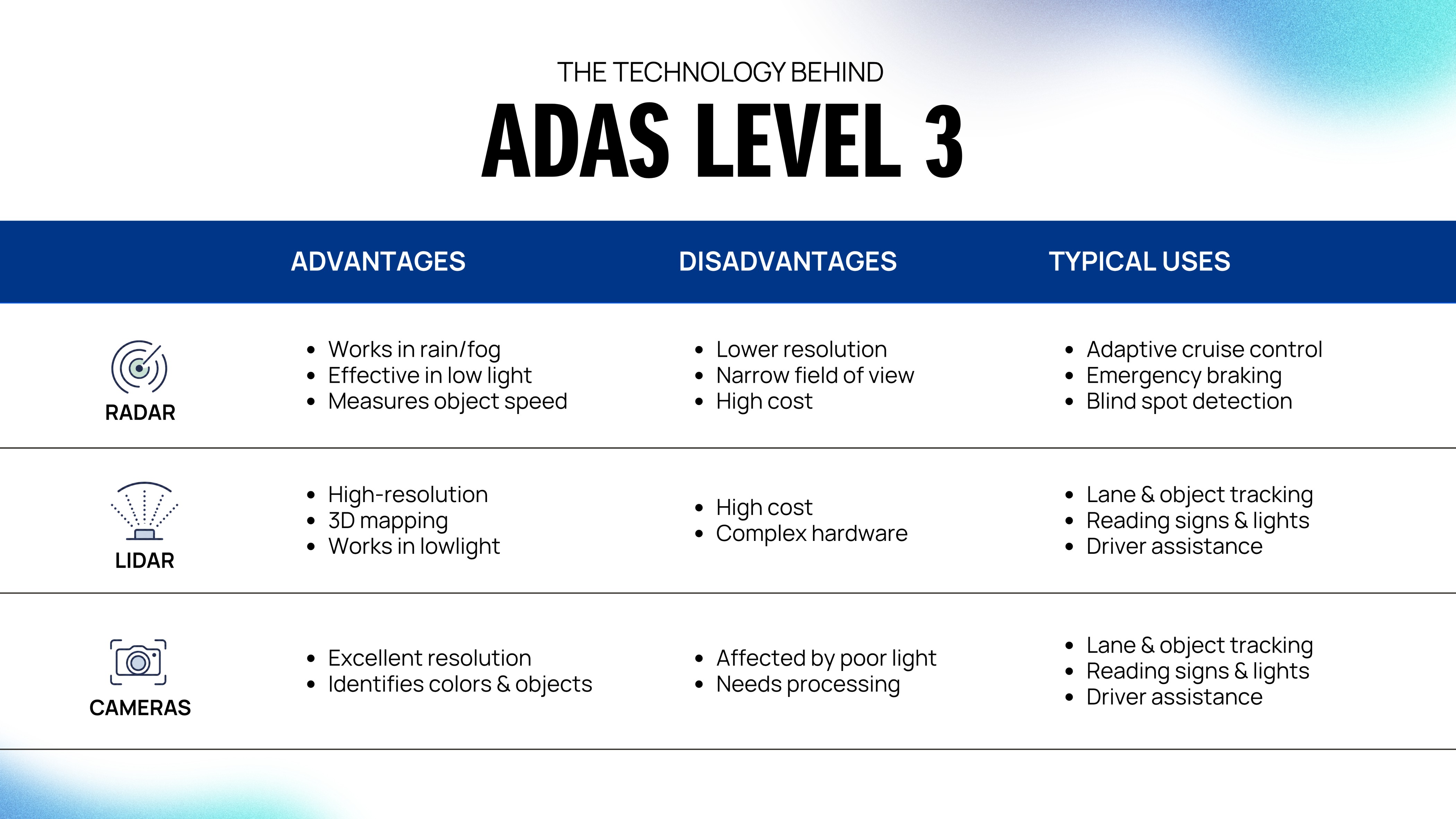
To achieve ADAS L3 autonomous driving, vehicles rely on three key sensor technologies to understand and interpret their surroundings: radar, LiDAR, & cameras.
1. Radar
Radar has been part of automotive safety systems since the mid-2000s, with early applications like blind spot monitoring. It works by sending out radio waves and detecting how they bounce back from nearby objects to measure both distance & speed.
Modern automotive radars operate at 77GHz, which allows for higher resolution and smaller antennas compared to older 24GHz systems. Radar is especially valuable in challenging weather conditions like rain or fog, where visibility is low. It’s commonly used in:
- Adaptive Cruise Control
- Collision Detection
- Blind Spot Monitoring
While radar is great for long-range tracking and poor visibility, its resolution & field of view are relatively limited compared to other technologies.
2. LiDAR
LiDAR functions similarly to radar but uses light pulses instead of radio waves, typically in the near-infrared spectrum (905nm or 1550nm). This gives lidar a much higher resolution, allowing it to create a detailed 3D map of the vehicle’s surroundings. It can detect:
- Lane markers
- Pedestrians
- Vehicles
- Roadside objects
Initially, LiDAR systems were large and expensive. However, automotive demand has led to more affordable LiDAR units. Still, LiDAR remains the most expensive of the three main sensor types and requires complex hardware.
3. Cameras
Cameras have evolved significantly over time. The first automotive backup camera was introduced in 1956, and by 2018, rear-view cameras became mandatory in ADAS level 3 cars.
Today, ADAS level 3 cars are equipped with:
- Blind-spot cameras
- 360-degree view systems
Cameras offer very high resolution and, when combined with advanced image processing, can accurately identify:
- Objects
- Traffic signs
- Lane markings
- Traffic lights
However, they are sensitive to poor lighting and weather conditions & require additional processing to determine distances.
Multi-Sensor Integration for Level 3 ADAS
To ensure accurate and safe performance in a wide range of driving scenarios, Suzuki R&D India uses a sensor fusion approach, combining radar, LiDAR, cameras, and even ultrasonic sensors.
A L3 ADAS system is integrated in Suzuki vehicles, and all of these technologies are used to create a detailed and reliable understanding of the vehicle’s surroundings. This multi-layered sensor strategy enhances both safety and performance, especially under real-world driving conditions.
The Role of Artificial Intelligence in ADAS Level 3 Automation
Artificial Intelligence (AI) is the backbone of ADAS Level 3 systems. AI handles data collection, processing, & decision-making in real time.
How AI powers ADAS Level 3?
- Real-Time Decisions: AI uses sensor data to understand the road-like lanes, obstacles, & traffic signs. This helps in making quick decisions to drive safely.
- Learning Over Time: AI systems improve with experience! They get better by collecting data from real-world driving & can receive updates via the internet.
- Sensor Fusion: AI combines inputs from multiple sensors to create a clear, accurate view of the surroundings.
These intelligent systems enable vehicles to function safely under complex but controlled conditions.
Challenges and Limitations
1. New Requirements for Service Centres
As Level 3 vehicles become more common, service centres will need:
- Special tools to calibrate sensors
- Trained staff to handle software updates
- Diagnostic tools to simulate and test automated systems
Automakers and component suppliers will need to support their service networks with modern tools and training programs.
2. Limited Availability of Smart Testing Zones
Effective deployment of Level ADAS 3 requires extensive real-world testing in controlled yet dynamic environments. However, dedicated smart testing zones remain limited. Key challenges include:
- Highways with embedded sensors and HD maps are still under development in many regions
- Urban zones with connected traffic infrastructure are not yet widely available
- Closed testing environments like industrial campuses are few and often restricted
This limited access to real-world testing zones slows down system validation, localisation, and the safe rollout of Level 3 capabilities.
3. Additional challenges
- Legal Issues: Laws around who is responsible in case of an accident are still being developed.
- Road Infrastructure: Most Indian roads are not equipped with high-definition mapping or lane markings.
- System Limitations: Quick handovers from the system to the driver must be smooth and safe.
- High Costs: L3 ADAS systems involve advanced hardware & software, increasing the overall cost of the vehicle.
Because of these challenges, most Level 3 vehicles are currently limited to developed markets or specific regions.
Overcoming ADAS Level 3 Challenges: Suzuki R&D India’s Approach
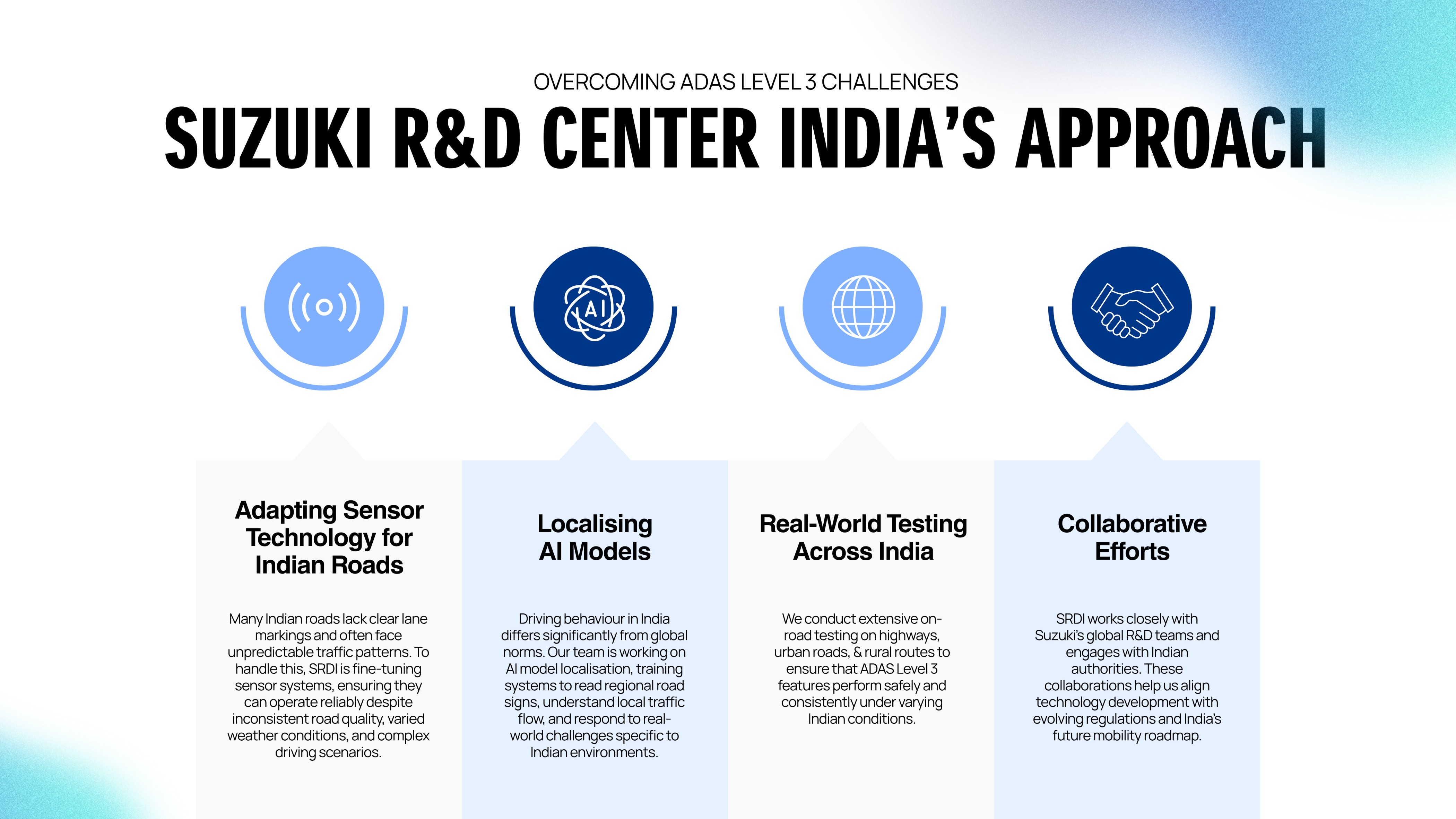
While ADAS L3 automation holds great promise, its adoption in India faces several challenges, from legal ambiguity and infrastructure limitations to system reliability and high costs. By localising technology for Indian conditions, SRDI is ensuring that semi-autonomous and eventually fully autonomous vehicles become a reality in India.
1. Adapting Sensor Technology for Indian Roads
Many Indian roads lack clear lane markings and often face unpredictable traffic patterns. To handle this, SRDI is fine-tuning sensor systems, ensuring they can operate reliably despite inconsistent road quality, varied weather conditions, and complex driving scenarios.
2. Localising AI Models
Driving behaviour in India differs significantly from global norms. Our team is working on AI model localisation, training systems to read regional road signs, understand local traffic flow, and respond to real-world challenges specific to Indian environments.
3. Real-World Testing Across India
We conduct extensive on-road testing on highways, urban roads, & rural routes to ensure that ADAS Level 3 features perform safely and consistently under varying Indian conditions.
4. Collaborative Efforts
SRDI works closely with Suzuki’s global R&D teams and engages with Indian authorities. These collaborations help us align technology development with evolving regulations and India’s future mobility roadmap.
The Way Forward
At Suzuki R&D India (SRDI), ADAS Level 3 is about building the foundation for autonomous driving on Indian roads. With a strong focus on innovation, safety, and real-world adaptation, we are making progress towards a future where semi-autonomous driving is not just a dream but a practical reality.
ADAS Level 3 is not just an upgrade; it’s a pivotal milestone in SRDI’s journey toward intelligent and dependable mobility!