

The Fossil Fuel Trap: Why India Needs CBG Beyond CNG?
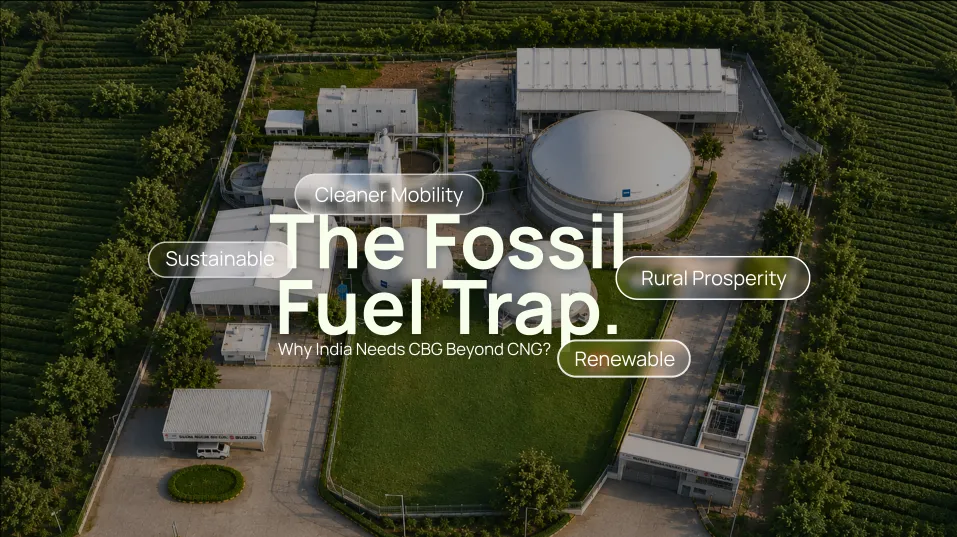
India is caught in a structural bind that few countries face at the same scale - one of the world's largest vehicle populations, billions spent on crude oil imports every year, & some of the world's most polluted cities. As fuel dependency grows, mobility is becoming increasingly expensive for everyone, whether one owns a private car, drives an auto-rickshaw, or relies on public transport. The cycle is self-reinforcing: rising vehicle ownership increases fuel demand, growing demand drives more fossil-fuel infrastructure, & even fuels India, once labelled "clean," like CNG, are beginning to look more like temporary fixes than long-term solutions.
Compressed Biogas, or CBG, is changing that, a fuel produced from the cattle dung, agricultural residue, & organic waste that India's farms and villages generate every single day, fully compatible with existing CNG vehicles, and already powering a cleaner future on the ground. Suzuki, a company that has moved to India for decades, has taken the defining next step, building the country's first automobile company-led CBG plants and turning India's greatest agricultural strength into its most promising energy asset.
Key Takeaways:-
|
What is the “Fossil Fuel Trap”?
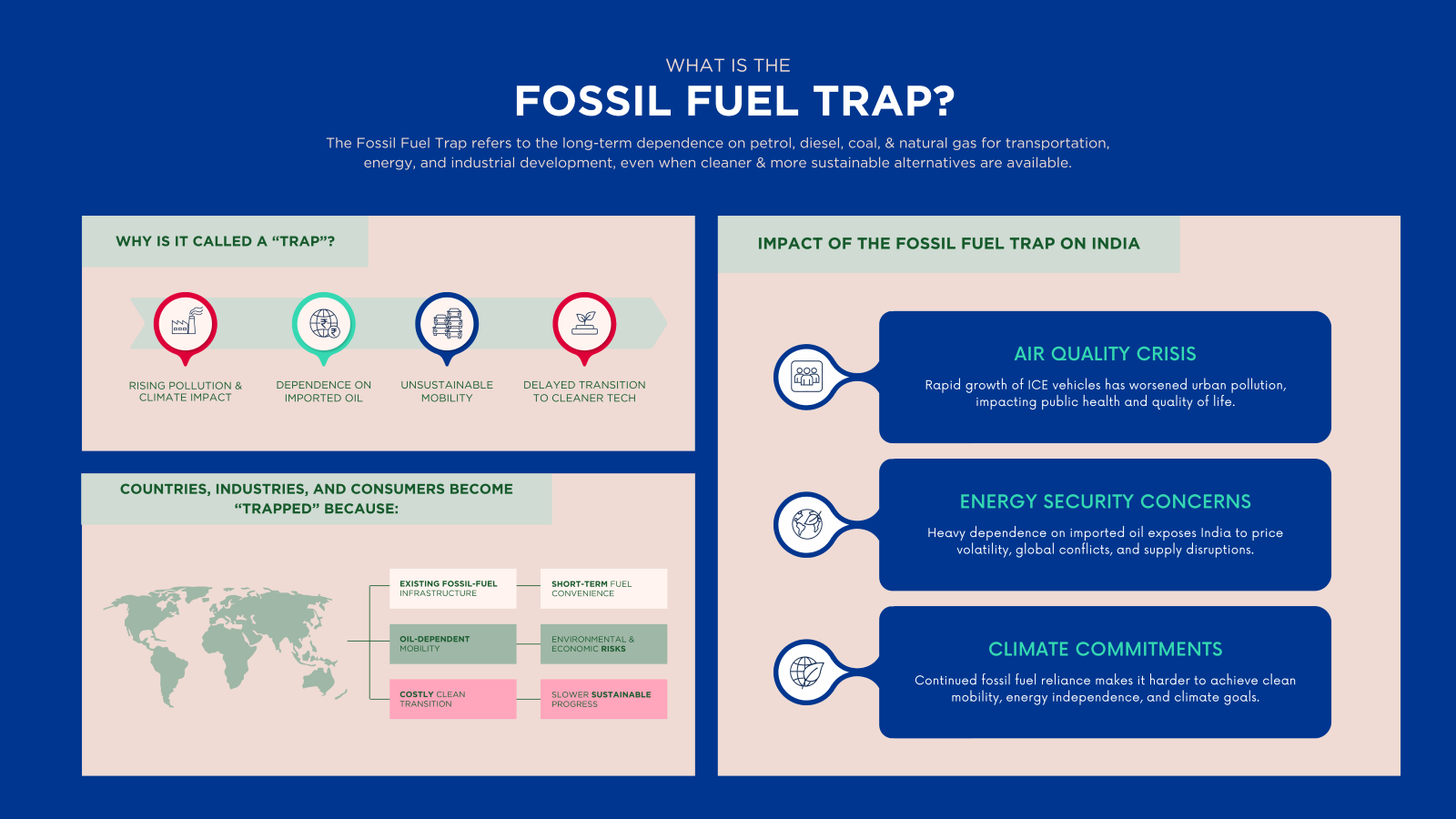
The Fossil Fuel Trap refers to the long-term dependence on petrol, diesel, coal, & natural gas for transportation, energy, and industrial development, even when cleaner & more sustainable alternatives are available. Countries, industries, and consumers become “trapped” because:
- Existing infrastructure is designed around fossil fuels.
- Vehicles & industries rely heavily on oil-based systems.
- Transitioning to cleaner mobility requires investment, policy support, & behavioral change.
- Fossil fuels often appear convenient and affordable in the short term.
Over time, this dependency creates serious environmental, economic, & public health challenges.
Why is it Called a “Trap”?
- Rising Pollution & Climate Impact
- Economic Dependence on Imported Oil
- Unsustainable Urban Mobility
- Delayed Transition to Cleaner Technologies
Impact of the Fossil Fuel Trap on India
Air Quality Crisis
Several cities in India regularly rank among the world’s most polluted urban areas. A large share of this pollution comes from ICE vehicles.
Did you know?
India's transport sector accounts for 13–14% of the country's total CO₂ emissions, with road vehicles being the dominant contributor. By 2024-25, the total number of registered vehicles have crossed 350 million around 2024–25. The rapid growth of ICE, CNG fuel vehicles & other fossil-fuel-based transport systems has improved connectivity but worsened pollution & import dependence. This harms:-
- Public health
- Increases respiratory
- Heart-related diseases
- Reduces workforce productivity
- Raises healthcare expenditure
- Lowers the overall quality of urban life
Energy Security Concerns
India imports a large portion of the crude oil needed to meet its transportation & industrial fuel demand. This makes the economy highly sensitive to:-
- Global oil price fluctuations
- International conflicts
- Supply chain disruptions.
Rising oil prices can increase transportation & manufacturing costs across the country. This affects businesses as well as household budgets.
Climate Commitments
India has committed to reducing carbon emissions intensity & increasing the use of clean energy in the coming decades. However, achieving these goals becomes difficult if transportation and industrial systems continue to depend heavily on fossil fuels.
The transition toward cleaner and sustainable transportation systems is essential for:-
- Long-term economic growth
- Energy independence
- Improved public health
- Stronger climate resilience
Is CNG Really a Clean Alternative?
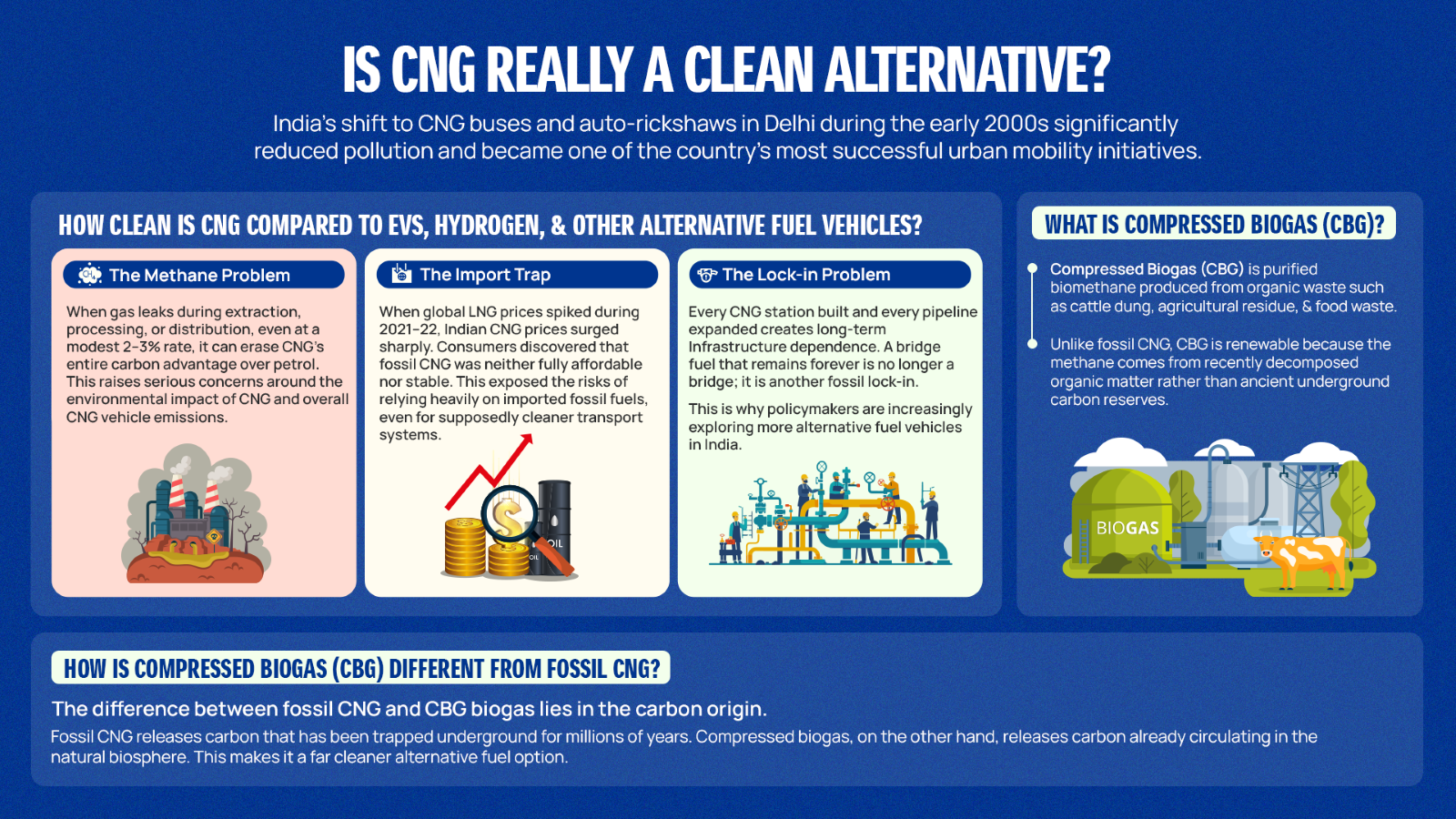
When India mandated the shift to CNG for Delhi's buses & auto-rickshaws in the early 2000s, the results were visible and real. Pollution levels improved significantly, and the move became one of the country’s most successful urban mobility solutions India had seen.
The rise of CNG-powered vehicles, such as natural gas cars, created the perception that CNG could permanently solve India’s pollution problem. But the reality is more complicated. Fossil CNG is still a fossil fuel, and India now needs to ask a harder question - “How clean is CNG compared to EVs, hydrogen, & other alternative fuel vehicles?”
The Methane Problem
Natural gas is predominantly methane. Over 20 years, methane is more than 80 times more potent as a greenhouse gas than CO₂.
When gas leaks during extraction, processing, or distribution, even at a modest 2–3% rate, it can erase CNG's entire carbon advantage over petrol. This raises serious concerns around the environmental impact of CNG and overall CNG vehicle emissions.
The Import Trap
When global LNG prices spiked during 2021–22, Indian CNG prices surged sharply. Consumers discovered that fossil CNG was neither fully affordable nor stable. This exposed the risks of relying heavily on imported fossil fuels, even for supposedly cleaner transport systems.
So, India needs alternative fuels for future mobility that are domestically produced, scalable, and less vulnerable to international energy shocks.
The Lock-in Problem
Every CNG station built and every pipeline expanded creates long-term infrastructure dependence. A bridge fuel that remains forever is no longer a bridge; it is another fossil lock-in.
This is why policymakers are increasingly exploring more alternative fuel vehicles in India.
What Is Compressed Biogas (CBG)?
Compressed Biogas (CBG) is purified biomethane produced from organic waste such as cattle dung, agricultural residue, & food waste.
Unlike fossil CNG, CBG is renewable because the methane comes from recently decomposed organic matter rather than ancient underground carbon reserves.
How Is Compressed Biogas (CBG) Different From Fossil CNG?
The difference between fossil CNG and CBG biogas lies in the carbon origin.
Fossil CNG releases carbon that has been trapped underground for millions of years. Compressed biogas, on the other hand, releases carbon already circulating in the natural biosphere. This makes it a far cleaner alternative fuel option.
Even more importantly, cattle dung-based biogas prevents methane from escaping into the atmosphere naturally. That gives CBG a dual environmental benefit, methane capture and fossil fuel replacement.
How Is Compressed Biogas (CBG) Produced?
The process inside a compressed biogas plant involves multiple stages:
Feedstock reception and pre-treatment
Fresh cow dung is collected, mixed with water, and homogenised for digestion.
Anaerobic digestion
In sealed, oxygen-free digesters, bacteria break down organic matter over several weeks, producing raw biogas containing roughly 55–65% methane and 35–45% CO₂.
Purification and upgrading
CO₂, hydrogen sulphide (H₂S), and moisture are stripped out using Pressure Swing Adsorption (PSA) technology, raising methane purity above 90%.
Compression
Purified biomethane is compressed to approximately 200 bar, the same standard as fossil CNG.
Dispensing
CBG is dispensed at on-site CNG-compatible filling stations. Hence, no new pump infrastructure is required.
These steps convert cattle dung and organic waste into clean transport fuel. Among the major compressed biogas uses, vehicle fuel is becoming one of the fastest-growing applications in India.
How Does CBG From Cattle Dung Benefit India?
Environmental Impact
Methane prevention
Sealed anaerobic digestion captures methane from cattle dung before it escapes into the atmosphere. Since methane is far more harmful than CO₂, this process helps reduce greenhouse gas emissions significantly.
Fossil fuel displacement
Each kilogram of CBG displaces approximately one kilogram of fossil CNG, preventing the release of ancient carbon into the atmosphere for the first time.
The Suzuki plants in Banaskantha, just two facilities, are together preventing the open decomposition of approximately 200 MT of cattle dung per day and displacing roughly 3 MT of fossil CNG daily. As additional plants come online through the NDDB Mrida JV, these numbers scale proportionally.
Economic Impact
New income stream from dung
Farmers supply fresh cow dung to the plant and receive direct payment, converting a zero-value or negative-value waste into a daily paid commodity.
Fertiliser dividend
Bio-slurry from the digestion process is returned free of charge to participating farmers as organic fertiliser, directly reducing their chemical fertiliser expenditure. It is one of the largest variable input costs for smallholder farmers.
Rural employment
Plant operations, dung collection logistics, fertiliser distribution, & maintenance create new non-agricultural employment in Banaskantha.
Approximately 25,000 farmers attended the Plant 1 inauguration at Agthala in December 2025. It is a number that speaks not just to media management but to the scale of rural buy-in already achieved.
India’s Policy Push for Compressed Biogas
SATAT scheme
The Government of India's SATAT scheme (Sustainable Alternative Towards Affordable Transportation, launched 2018) provides guaranteed long-term offtake agreements for CBG through oil marketing companies, alongside capital subsidies and a clear regulatory framework.
As of mid-2025, 108 CBG plants are operational under SATAT, with 1,094 active letters of intent. It is a pipeline roughly 10 times the installed base.
CBG Blending Obligation
The CBG Blending Obligation that was introduced in 2024 mandates:
- 1% of all CNG and PNG supply must be CBG from FY 2025-26
- From 2028-29 onwards, CBO will be 5%
This converts CBG demand from discretionary to mandated by law.
Note:- Every City Gas Distribution (CGD) operator in India is now legally required to source and blend CBG into its supply. The policy is expected to catalyse ₹37,500 crore in investments and 750 CBG projects by FY 2028-29. The blending mandate makes this growth curve steeper, not flatter.
The Biggest Challenges in India’s CBG Sector
Feedstock aggregation consistency
Ensuring a reliable, year-round supply from thousands of dispersed smallholders is the industry's hardest operational challenge.
A 2025 TERI study found that 11 CBG plants surveyed in northern India were inactive, primarily due to feedstock supply and operational challenges.
The Suzuki model's integration with an existing dairy cooperative logistics network is its single most important structural advantage over standalone CBG operators.
Technical operator capability
PSA purification systems and biogas upgrading technology require trained operators. The CBG industry currently faces a skills gap that will constrain scale-up speed in states without existing industrial training infrastructure.
Distribution infrastructure
Getting CBG from the production site to the pump requires either pipeline injection into the gas grid or cascade cylinder distribution.
Both require investment. Rural and semi-urban areas, precisely where most CBG will be produced, are often furthest from existing CGD pipeline infrastructure.
Plant economics at the small scale
Government-set SATAT offtake pricing provides a revenue floor but limits upside. The profitability of individual plants depends heavily on feedstock cost control, byproduct (fertiliser) revenue, & carbon credit monetisation, the last of which remains largely unlocked.
Suzuki has overcome many CBG industry challenges by integrating CBG production with dairy cooperative networks for steady dung collection, smoother operations, easier logistics, & better plant efficiency.
The Suzuki Model: Turning Rural Waste Into Transport Fuel
SRDI has launched India's first automobile-company-led, cattle dung to Compressed-Biogas initiative in Banaskantha, Gujarat, in partnership with the National Dairy Development Board (NDDB) and Banas Dairy.
Each plant processes approximately 100 MT of cow dung per day and produces around 1.5 MT of CBG daily. This is enough to fuel roughly 250 CNG vehicles per plant per day.
Future of Compressed Biogas (CBG) in India
India’s CBG journey is moving from pilot scale to system-level integration. The next phase will not be about proving the concept, but about scaling infrastructure, improving supply chains, and integrating CBG into India’s broader energy mix.
If execution continues at the current policy and industrial pace, CBG will reshape India’s mobility ecosystem by 2030–2035 through three key shifts:
- Reduced dependence on imported fossil fuels
- Expansion of circular rural energy economies
- Integration with India’s existing CNG-based transport network
Rather than replacing EVs or hydrogen, CBG will stabilise India’s transition phase by ensuring that current mobility systems become cleaner while new technologies scale.
Compressed Biogas will allow India to make the existing system cleaner, more circular, and less dependent on fossil imports. Initiatives like the Suzuki-NDDB-Banas Dairy partnership show that this transition is already possible at scale.
The challenge now is no longer the idea; it is an execution!