

How Biogas is Powering the Future of Sustainable Transportation?
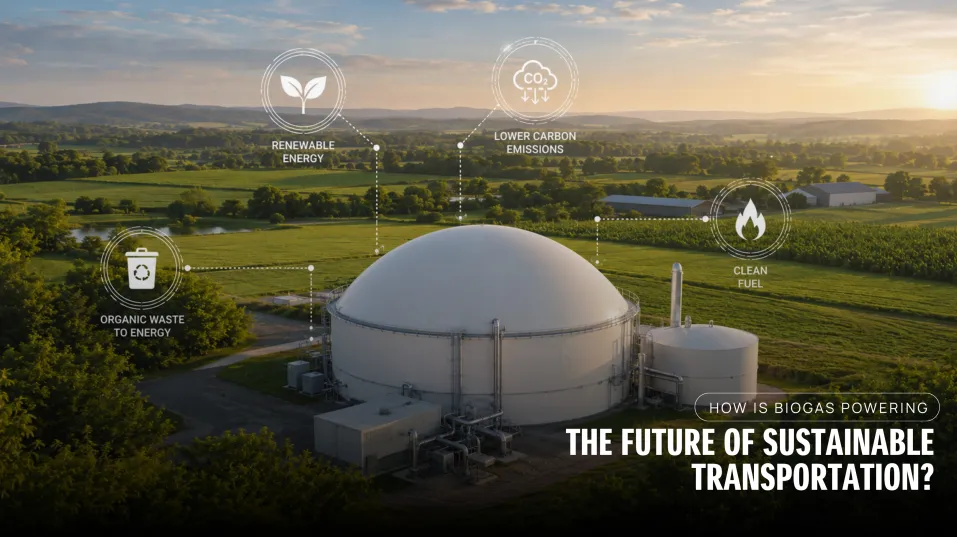
Biogas is rapidly emerging as one of the most practical solutions for eco friendly transportation & sustainable mobility. It converts organic waste into renewable fuel that can reduce greenhouse gas emissions by 60% - 80% compared to conventional fuels.
Key Takeaways
|
What Is Biogas & Why Does It Matter for Eco Friendly Transportation?
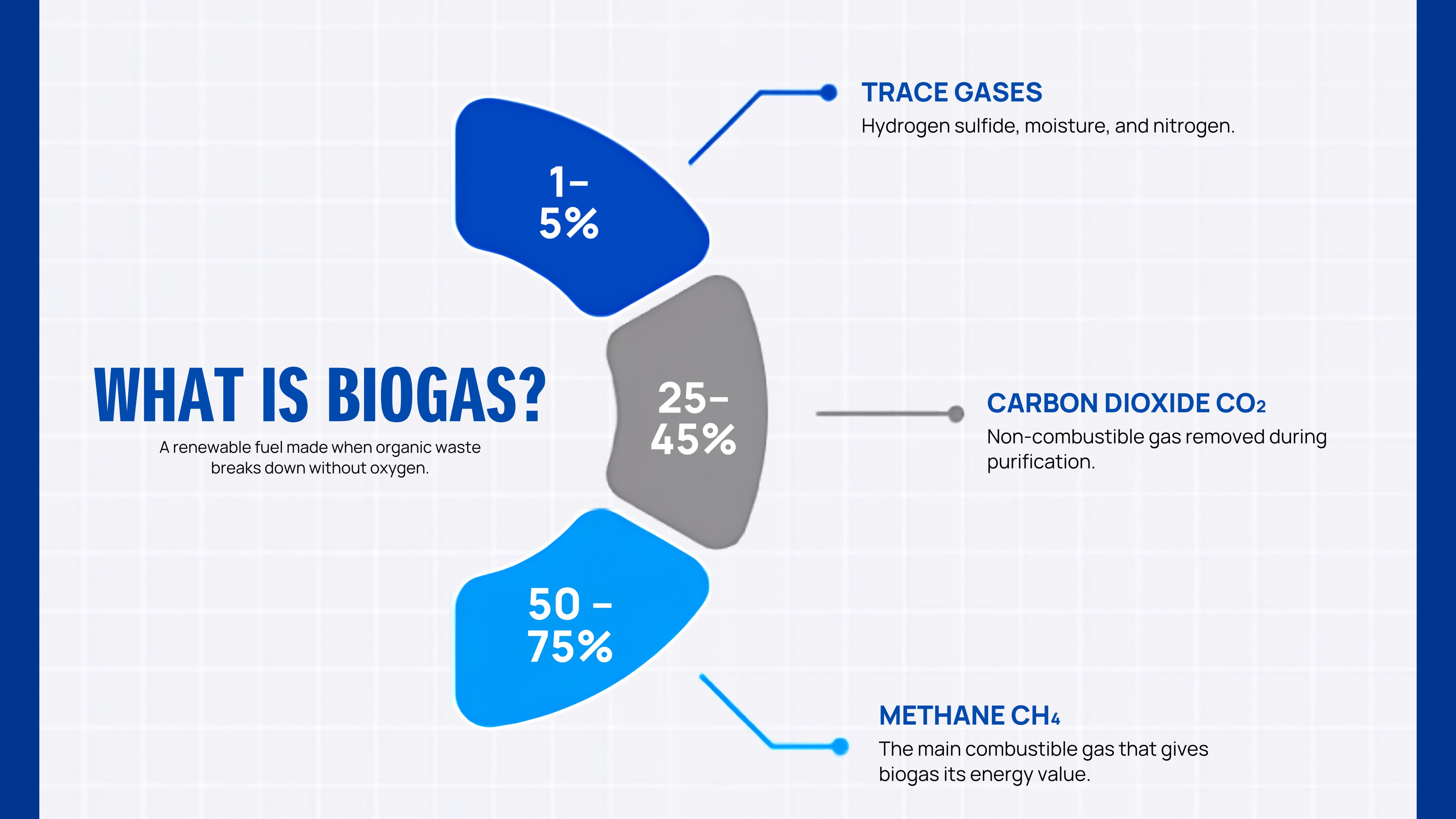
Biogas is a renewable fuel produced when microorganisms break down organic matter. This includes cattle dung, food processing waste, crop residue, & sewage sludge in a sealed, oxygen-free environment.
This biological process, called anaerobic digestion, releases a combustible gas mixture that can be captured, purified, & used as energy. Raw biogas is primarily composed of:
- Methane (CH₄): 50–75%
- Carbon dioxide (CO₂): 25–45%
- Trace gases: hydrogen sulfide, moisture, & nitrogen- 1-5%
For eco friendly transportation, use raw biogas. It is purified into biomethane or Compressed Biogas (CBG), raising the methane concentration above 90%. The result behaves almost identically to conventional Compressed Natural Gas (CNG). This means existing CNG vehicles can run on CBG with little/ no engine modification.
Why is Biogas considered a Renewable Fuel?
Biogas qualifies as a renewable energy fuel for one fundamental reason. Its feedstocks are continuously regenerated:-
- Farms produce manure every day
- Food factories generate waste every shift
- Municipalities produce organic solid waste around the clock
Unlike fossil fuels, which took millions of years to form, the raw material for biogas is essentially infinite. This makes biogas in transportation a compelling green fuel alternative in ways that other low-carbon options are not yet.
Benefits of Biogas in Sustainable & Eco Friendly Transportation
Carbon Emission Reduction in Transport
Biogas significantly reduces lifecycle carbon emissions compared to fossil fuels. When organic waste decomposes in the open, in fields, landfills, or open piles. It releases methane directly into the atmosphere.
Methane is roughly 80 times more potent than CO₂ as a greenhouse gas over a 20-year horizon. Biogas systems capture that methane & convert it into usable energy instead of allowing it to escape. This creates a double environmental benefit:-
- Prevents methane release from landfills
- Replaces fossil fuel consumption in transportation.
In some cases, waste-derived biogas can achieve near-negative carbon intensity. It removes more greenhouse gas from the atmosphere than it creates.
The impact of biogas on clean transportation significantly outperforms petrol & diesel.
Urban Air Quality Improvements
For cities struggling with dangerous air pollution levels like India, biofuel-powered cars can deliver measurable public health benefits. Vehicles powered by compressed biogas emit significantly lower:-
- Particulate matter (PM2.5)
- Nitrogen oxides
- Virtually no sulfur dioxide
Energy Security & Import Independence
Countries like India that are dependent on alternative energy for transportation face constant price volatility & geopolitical risk.
Biogas changes this equation: The raw material/ organic waste exists locally & is continuously regenerated. Farms, food industries, municipalities, & wastewater systems never stop generating organic waste. This allows India to:-
- Produce part of its transportation fuel domestically
- Reducing import dependency
- Stabilising fuel pricesf
Five Stages of Biogas Production for Eco-Friendly Transportation
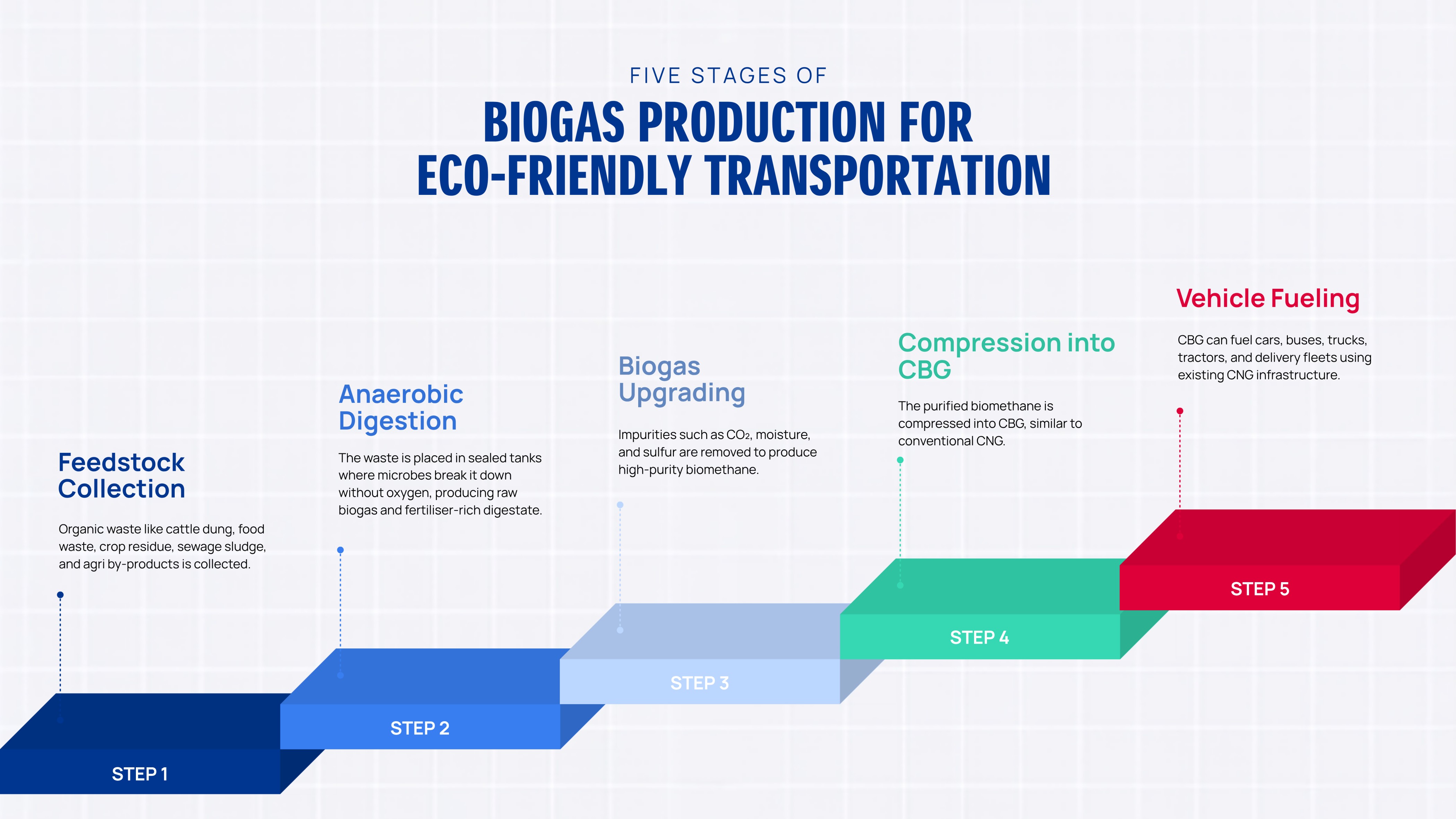
Stage 1: Feedstock Collection
The process begins with collecting organic waste materials, the feedstock. In agricultural economies like India, cattle dung is one of the most abundant & consistent feedstocks available.
Unlike food waste, which varies seasonally, dairy farms generate manure year-round. This makes it a highly reliable raw material for large-scale biogas production. Common feedstocks include:-
- Cow dung & cattle manure
- Municipal organic solid waste
- Food processing waste & kitchen scraps
- Sewage sludge from wastewater plants
- Crop residue
- Agricultural by-products
- Sugar industry by-products
Stage 2: Anaerobic Digestion
Feedstock is placed inside sealed tanks called digesters. Microbial communities break down organic matter in the complete absence of oxygen over several weeks. This biological process produces raw biogas & a semi-solid by-product called digestate. This becomes high-quality organic fertiliser.
Stage 3: Biogas Upgrading
Raw biogas contains impurities like carbon dioxide, moisture, & sulfur compounds that must be removed before the gas is suitable for vehicle use.
The three most common upgrading technologies are:
- Pressure Swing Adsorption (PSA) — Uses pressure to separate CO₂ from methane
- Water Scrubbing — Dissolves CO₂ in pressurised water
- Membrane Separation — Uses selective permeability to purify the gas
Each method produces high-purity biomethane ready for compression.
Stage 4: Compression Into CBG
Purified biomethane is compressed into CBG at refuelling stations. This step mirrors the process used for conventional CNG. It allows the same dispensing equipment to serve both fossil & renewable gas.
Stage 5: Fueling Biogas-Powered Vehicles
CBG can power a wide range of vehicles. From auto-rickshaws & passenger cars to city buses, long-haul trucks, agricultural tractors, & commercial delivery fleets.
Because the fuel works within existing CNG infrastructure:-
- The adoption curve is faster
- More affordable than switching to electric or hydrogen alternatives, which require purpose-built networks
The Circular Economy in Action
Biogas is one of the clearest real-world examples of circular economy principles applied to green mobility solutions. Instead of creating pollution, the waste stream becomes economically productive at every step:
Real-World Applications of Biogas Powered Vehicles
Biogas-powered transportation is no longer experimental. It is already operating at commercial scale across multiple vehicle sectors globally, & the advantages of biogas-powered vehicles are increasingly evident in fleet economics as well as environmental performance.
Public Bus Fleets
In India, cities such as Pune are actively exploring cleaner public transportation systems powered by renewable compressed gas, supported by national policy initiatives including the SATAT scheme.
Long-Haul Trucking & Bio-LNG
It is one of the hardest sectors to electrify because batteries become prohibitively heavy & expensive at freight distances.
Bio-LNG and CBG provide an effective biogas as an alternative to petrol and diesel for heavy-duty freight.
Agricultural Mobility & Rural Energy
In rural economies, smaller biogas systems are already powering irrigation pumps, farm tractors, & intra-village transport.
This creates decentralised energy ecosystems where communities generate their own clean fuel from agricultural waste produced on-site - with no dependence on centralised fuel distribution networks.
Biofuel Powered Cars
The growing demand for biofuel powered cars is showing how clean fuels can support the future of sustainable transportation. Biofuel for cars & other vehicles helps to:-
- Reduce Pollution
- Lower Fossil fuel dependence
- Promote eco-friendly mobility solutions
Government Policy Driving India's Biogas Sector
India's position as one of the world's most agriculturally productive economies, with one of the largest cattle populations globally. This makes it uniquely positioned to scale biogas fuel production. Government policy is now actively accelerating this potential.
The SATAT Scheme
The Government of India launched the SATAT (Sustainable Alternative Towards Affordable Transportation) initiative to encourage large-scale CBG production across the country. The scheme provides:-
- Long-term fuel purchase agreements for CBG producers
- Infrastructure development support
- Frameworks for private investment participation
CBG Blending Mandates and Pipeline Integration
India has introduced mandatory blending targets for CBG in gas supply networks. This ensures stable & long-term demand growth for renewable gas production.
The Indian government has expanded the CBG-CGD Synchronisation Scheme to allow the injection of compressed biogas directly into the national gas pipeline network. It will dramatically improve distribution reach for biogas plant operators across India.
India's CBG Production Potential
India's potential CBG production capacity is enormous. Key feedstocks include cattle dung (one of the world's largest available supplies), crop residue, municipal organic solid waste, sewage and wastewater, and sugar industry by-products. The resource base exists at scale. The primary challenge now is execution speed and infrastructure expansion.
SRDI’s Cattle-Dung-to-CBG Initiative in India
Suzuki R&D India, in partnership with the National Dairy Development Board & Banas Dairy, has launched a large-scale cattle-dung-to-CBG initiative in Gujarat.
The project converts cattle waste from dairy farmers into two valuable outputs:
- Renewable transportation fuel (CBG)
- Organic fertiliser (digestate)
The Three Problems that Suzuki set out to solve
Problem 1: Methane emissions from open waste decomposition
India has one of the world's largest cattle populations. When cattle dung decomposes in the open, it releases methane directly into the atmosphere. It is a waste infrastructure gap as much as an environmental one.
Problem 2: Limited income for dairy farmers
India already has a strong cooperative system for selling milk, but cattle dung was never part of an organised market.
The CBG ecosystem changes this by purchasing dung directly from farmers. This will create a steady rural income source using existing dairy cooperative networks.
Problem 3: Fossil fuel import dependency
India continues to rely heavily on imported fossil fuels for transportation. Domestically produced biogas helps reduce this dependency. It also strengthens local fuel production capacity.
How does the Model Work?
Cow dung is collected through existing dairy cooperative networks associated with Banas Dairy. This gives the project a major advantage because logistics, farmer relationships, & payment systems are already in place.
The collected dung is processed into clean biogas fuel for vehicles. It is then supplied through existing CNG refuelling infrastructure, while the remaining digestate is converted into organic fertiliser and returned to farmers. It will help reduce dependence on expensive chemical fertilisers.
Key Challenges Facing Biogas Powered Transportation
Despite its promise, the biogas industry still faces obstacles that must be addressed for full-scale adoption. These are engineering, policy, & financing challenges.
Feedstock Logistics
Collecting & transporting organic waste regularly can be difficult, especially across large rural areas. Building a reliable feedstock supply chain requires:-
- Proper coordination
- Investment
- Strong local partnerships
Infrastructure Expansion
CBG plants, upgrading systems, compression facilities, & distribution networks all require significant upfront capital investment before generating returns.
Scaling a biogas plant in India to commercial viability requires both technical expertise & patient capital.
Workforce and Technical Operations
Biogas digesters must be operated carefully to maintain stable gas production & plant efficiency.
Building a trained local workforce capable of running these systems at scale takes time & consistent investment in training programs.
Project Financing
Many projects require large upfront capital before achieving long-term profitability.
Access to affordable financing, particularly for smaller rural plants, remains a critical barrier in developing markets.
The Future of Biogas Fuel in Transportation
The future of sustainable transportation using renewable fuels will not depend on any single technology. Battery EVs will likely dominate urban passenger mobility & short-distance travel. On the other hand, hydrogen may serve specific industrial, aviation, & heavy infrastructure applications.
Biogas, in the form of CBG & Bio-LNG, is positioned to become critical for commercial fleets, rural transportation, agricultural mobility, & decentralised fuel systems.
Strong global momentum for biomethane as a transport fuel continues to grow in 2026 across road, maritime, & aviation sectors.
Conclusion
Biogas is emerging as a practical and scalable solution for sustainable transportation, particularly in agricultural economies like India. Converting organic waste into clean fuel, it helps reduce greenhouse gas emissions, lowers fossil fuel dependence, improves air quality, and supports rural economic development.
Its compatibility with existing CNG infrastructure makes adoption faster and more cost-effective than many alternative fuel technologies. Initiatives such as Suzuki R&D India’s cattle-dung-to-CBG project further highlight the potential of biogas in building a cleaner and more sustainable transportation ecosystem for the future.