
What Is Automotive Aerodynamics in Cars?

Automotive aerodynamics minimises drag & manages lift to enhance fuel efficiency, speed, and safety. It uses techniques like sleek vehicle shapes to reduce air resistance. Advanced tools such as Computational Fluid Dynamics (CFD) & wind tunnels are used to optimise these designs. These tools help create smooth, low-drag shapes, often with a drag coefficient (Cd)(C_d)(Cd) between 0.20 & 0.25.
Features such as spoilers, diffusers, & active aerodynamic systems are added to improve cornering grip. They also help reduce air resistance & enhance overall performance.
Key Fundamentals & Principles of Automotive Aerodynamics
Drag Reduction
Drag is the resistance created when air pushes against a moving car. One of the main goals of automotive aerodynamics is to reduce this drag. Hence, the vehicle can move more efficiently.
Lower drag improves fuel economy. It allows the car to achieve better top speeds optimally.
Engineers reduce drag by:-
- Designing smooth body shapes
- Adding underbody panels
- Using features such as active grille shutters.
These shutters close when engine cooling is not required, helping explain the true aerodynamic meaning in vehicle design.
Lift Management
Lift is the upward force produced when air flows beneath & over a vehicle. If the lift is not properly controlled, it can reduce tyre grip and make the car unstable. This works great, especially at higher speeds.
Aerodynamics in cars focuses on managing lift. As a result, the tyres remain firmly on the road & improve:-
- Braking
- Cornering
- Overall driving safety
Lift management is a key part of aerodynamics in cars.
Downforce Generation
Downforce is the opposite of lift & is mainly used in aerodynamic cars designed for high performance. It employs components such as:-
- Spoilers
- Wings
- Diffusers.
By using these components, automotive aerodynamics engineers create downward pressure that increases traction & improves cornering ability. In modern vehicles, active aerodynamics adjusts these components automatically based on speed and driving conditions to balance performance & efficiency.
Stability
Stability is an important result of good car aerodynamics. As air flows around a vehicle, uneven airflow can cause unwanted movement, especially in strong crosswinds or during sudden manoeuvres.
Automotive designers manage airflow separation & balance the centre of pressure with the vehicle’s centre of gravity. This improves straight-line stability and ensures a controlled & confident driving experience.
Pressure & Velocity
Air speeds up over curved surfaces (like the roof). As a result, the airflow behaves differently across vehicles:-
- Creating low pressure
- Slowing down at the front
- Creating high pressure, which helps push air through intakes.
How Automotive Aerodynamics Works?
Works through carefully designed elements & techniques that guide airflow smoothly around the vehicle.
Streamlined Shapes
Most aerodynamic cars have smooth & flowing body shapes. Tapered bodies, sloping bonnets, and gentle curves help air move easily over the car instead of hitting it. This reduces air resistance & helps improve fuel efficiency.
Frontal Area
When a car has a larger front area, it hits more air as it moves, which makes it harder to move forward & increases air resistance (drag).
A smaller front area allows air to flow around the car more easily. This reduces drag & helps the car move more efficiently.
This directly affects:-
- Fuel efficiency
- Top speed
- Overall performance.
This is why designers try to keep the frontal area as compact as possible without compromising safety or comfort.
Spoilers, Wings, & Diffusers
Spoilers, wings, & diffusers are usually placed at the rear of the car. They help control how air leaves the vehicle. By reducing lift & creating downforce, these parts improve grip and stability, especially when driving at higher speeds.
Air Curtains
Air curtains guide air around the wheels of the car. Since wheels create a lot of air disturbance, air curtains help reduce turbulence in this area. This improves overall aerodynamics in cars & supports better efficiency.
Active Aerodynamics
Some modern cars use active aerodynamics, where parts like spoilers or air openings move automatically.
These parts change their position based on the car’s speed & driving conditions. This helps the car get:-
- Better performance
- Improve stability
- Save fuel.
CFD & Wind Tunnel Testing
Automotive aerodynamics engineers use tools like Computational Fluid Dynamics (CFD) & wind tunnels to study airflow around a car.
- CFD allows engineers to test & improve designs on a computer.
- Wind tunnels are used to physically test the car under controlled airflow conditions.
These tools help improve aerodynamics, performance, & efficiency before the car goes into production.
Undercarriage
A smooth underbody with diffusers accelerates airflow underneath. It creates low pressure for downforce, which improves the grip.
Why Automotive Aerodynamics Matters?
Fuel Efficiency
Goohave to work as hard. It also saves fuel & improves mileage, making the car more economical to run. d automotive aerodynamics reduces air resistance. This means the engine does not
Performance
When a car is designed with proper aerodynamics, it can move faster & accelerate better.
Less air resistance means the engine uses its power more efficiently. This results in higher top speeds & a smoother driving experience.
Stability & Safety
Automotive aerodynamics also improves vehicle stability. Proper airflow management generates downforce, which helps keep the tyres firmly in contact with the road. This improves safety during high-speed driving & sharp turns.
Benefits of Automotive Aerodynamics
Better Fuel Economy
Good car aerodynamics reduces air resistance, also called drag. When there is less drag, the engine needs less effort to move the car. This helps improve fuel economy & makes the vehicle more efficient.
Improved Handling & Safety
Aerodynamics in cars helps control airflow and create downforce. This keeps tyres firmly on the road, improving grip & stability. Better control makes the car safer and easier to handle, especially at higher speeds.
Reduced Wind Noise
Smooth airflow is an important part of automotive aerodynamics. It reduces air turbulence around the car. This helps lower wind noise inside the cabin.
As a result, it improves driving comfort for passengers.
Design Techniques for Efficiency, Stability, & Handling in Automotive Aerodynamics
Design Techniques for Efficiency
Process Efficiency
- Pareto Principle (80/20 Rule): Focus on the few design tasks that deliver the maximum value instead of spending excessive time on minor details.
- Minimum Viable Product (MVP): Develop the core design first to solve the main problem quickly before expanding features.
- Standardisation & Templates: Use predefined design systems and templates to save time and maintain consistency.
- AI Tools & Automation: Use intelligent software to automate repetitive design tasks and improve productivity.
- Rapid Prototyping: Create simple prototypes early to test ideas and avoid costly design changes later.
- Performance Modelling: Analyse usage and performance data to allocate the right resources and reduce waste.
- Passive & Active Design: Combine natural design elements with energy-efficient systems for better performance.
- Lean Engineering: Reduce material waste while improving product quality and usability.
- Low-Power Circuit Design: Design electronic systems that consume less power and improve energy efficiency.
- Generative Design: Use computer algorithms to create lightweight, strong, and optimized designs.
Collaborative Efficiency
- Model-Based Definition (MBD): Use 3D models as the primary reference so teams can work from a single source and reduce errors.
- Delayed Engineering: Finalize detailed designs only after all requirements are confirmed to avoid rework.
Design Techniques for Stability & Handling
Vehicle & Aerospace Design
- Static Margin Optimisation: Position the centre of gravity correctly to improve vehicle or aircraft stability.
- Vortex Lattice & Panel Methods: Use simplified aerodynamic tools to study airflow in early design stages.
- Active Stability Control: Use steering and torque control systems to enhance vehicle handling and safety.
- Suspension Optimisation (MOPSO): Optimize suspension design to improve cornering performance and vehicle control.
Control Systems
- Routh-Hurwitz Criterion: Check system stability without solving complex equations.
- Nyquist Stability Criterion: Analyse system stability using frequency response graphs.
- Root Locus Method: Understand how system behaviour changes as control parameters vary.
- Bode Plot Analysis: Measure gain and phase margins to ensure stable system performance.
Structural Stability
- Second-Order Elastic Analysis: Consider structural imperfections to prevent failure under heavy loads.
- Limit Equilibrium Analysis: Calculate safety factors to prevent structural or slope failure.
- Internal Lattice Structures: Improve strength and stability by using internal support structures.
- Preventive Safety Design: Integrate safety features such as earthquake resistance during the design stage.
Advanced Aerodynamic Technologies in Modern Vehicles
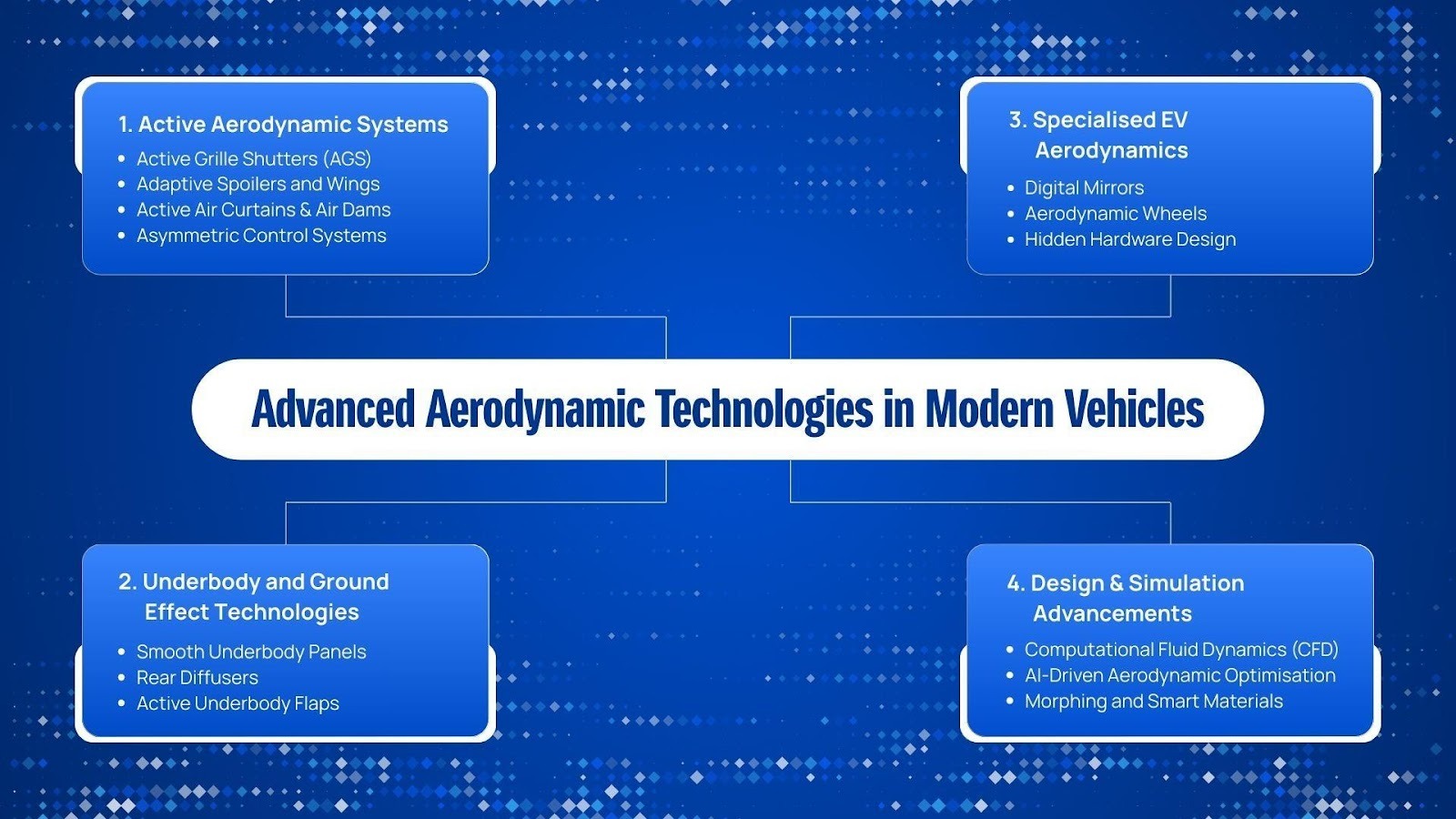
1. Active Aerodynamic Systems
- Active Grille Shutters (AGS)
- Adaptive Spoilers and Wings
- Active Air Curtains & Air Dams
- Asymmetric Control Systems
2. Underbody and Ground Effect Technologies
- Smooth Underbody Panels
- Rear Diffusers
- Active Underbody Flaps
3. Specialised EV Aerodynamics
- Digital Mirrors
- Aerodynamic Wheels
- Hidden Hardware Design
4. Design & Simulation Advancements
- Computational Fluid Dynamics (CFD)
- AI-Driven Aerodynamic Optimisation
- Morphing and Smart Materials