

What is CAE in the Automotive Industry?

In the automotive industry, CAE stands for Computer-Aided Engineering. It involves using advanced computer software to simulate, analyse, and optimise vehicle designs even before any physical prototype is built.
This digital simulation assists engineers in virtually testing & refining different aspects such as structural integrity, aerodynamics, & crash safety, leading to faster development times, reduced costs, & improved product quality.
How CAE (Computer-Aided Engineering) Works in the Automotive Industry?
CAE works by using advanced computer software to simulate & analyse product designs before any physical prototype is created. It follows a clear three-step process. They are as follows:-
1. Preprocessing
This is the first stage, where engineers prepare the design for simulation.
- Engineers import a Computer-Aided Design (CAD) model created using automotive design software or other computer-aided engineering programs.
- They add details such as material type, loads, environmental conditions, & movement.
- The design is then divided into small elements through Finite Element Analysis (FEA). It helps the software to study every section of the model with high accuracy.
This setup ensures that the computer-aided structural engineering process begins with complete & correct data.
2. Solving
In this step, the CAE system performs complex calculations.
- The CAE tools use mathematical equations & physics-based models to simulate how the design will behave in real-life situations.
- This may include stress analysis, Computational Fluid Dynamics (CFD) for aerodynamics, thermal analysis, vibration checks, & more.
- These simulations help engineers understand performance without needing expensive physical testing.
The solving step is the core of CAE simulation. It allows auto manufacturers to test different design options quickly.
3. Postprocessing
This is the final stage, where engineers study the simulation results.
- The CAE software provides clear visual outputs. This includes colour maps, stress plots, deformation diagrams, & flow patterns.
- These visuals make it easy to spot weaknesses, errors, & improvement areas.
- CAE Engineers can then adjust the design to improve performance, durability, safety, & efficiency before moving to production.
Postprocessing helps teams make informed decisions in automotive product design, supporting better quality & faster development.
Benefits of Using CAE in the Automotive Industry
1. Lower Development Costs
Computer-Aided Engineering (CAE) helps reduce the need for multiple physical prototypes. With CAE simulation & computer-aided engineering tools, engineers can run virtual tests instead of building expensive models. This makes the automotive design process more efficient and lowers overall development costs.
2. Faster Development
Using CAE software and automotive design software, engineers can detect and correct issues early in the virtual stage. This speeds up the entire workflow, allowing companies to bring new vehicles to market faster. It is a major advantage in today’s competitive automotive design industry.
3. Better Quality & Performance
Through powerful CAE engineering and computer-aided design and analysis, vehicles are tested in many different simulated conditions. This leads to better-performing, more durable products. By using modern CAE programmes & CAE systems, automobile manufacturers can achieve higher quality standards.
4. Improved Safety
Virtual crash testing using CAE tools & other computer-aided structural engineering strategies allow engineers to study crash behaviour in detail. This helps improve automotive product design, resulting in safer vehicles for real-world driving. CAE has become a key part of safety testing in modern engineering.
5. Essential for New Technologies
Emerging technologies such as electric vehicle batteries, ADAS systems, & autonomous sensors require accurate CAE simulation software for design and optimisation. CAE supports innovation & plays a major role in the future of CAE, making it vital for the next generation of automotive design engineering.
Key applications of CAE in the automotive industry
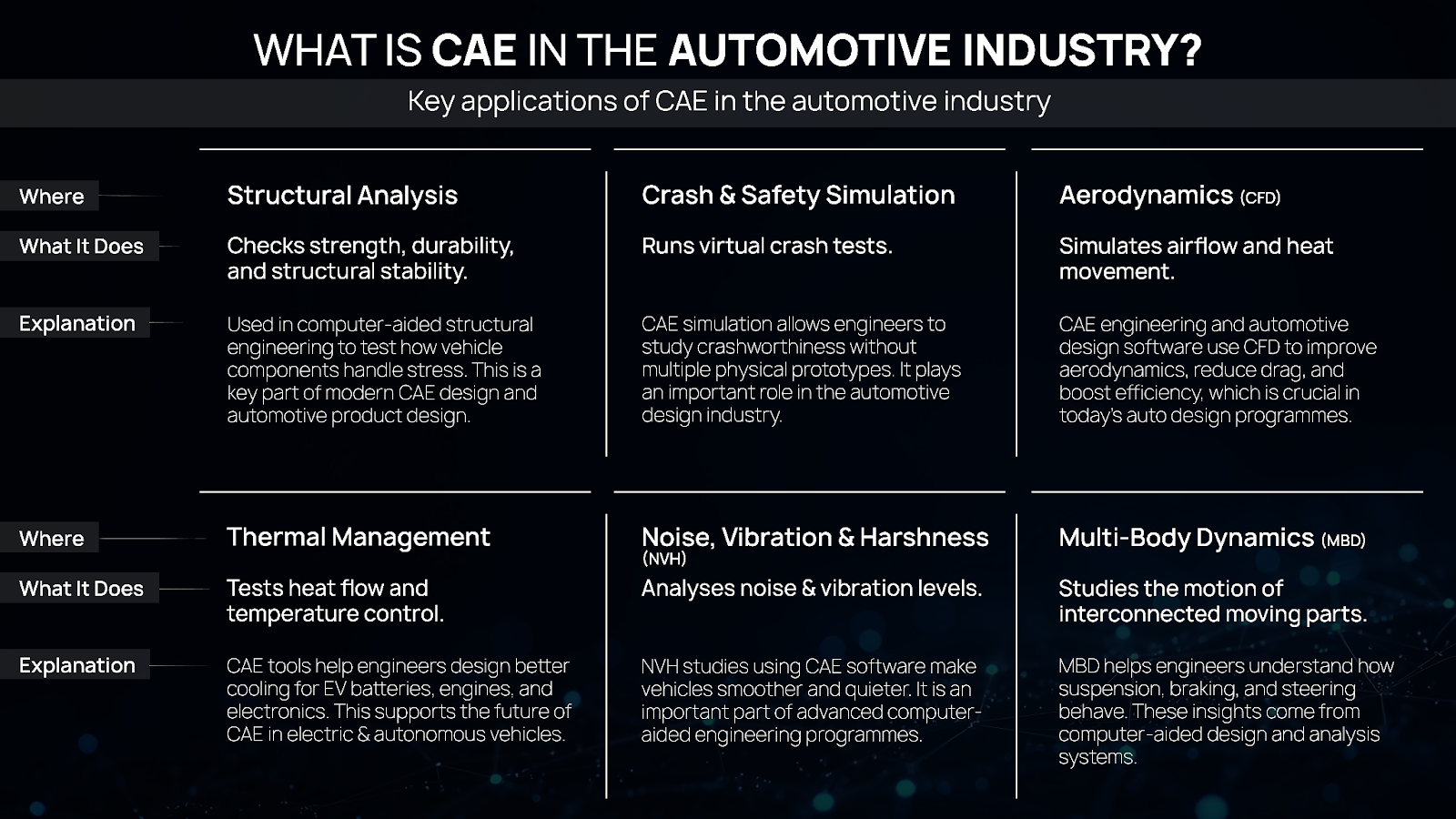
- Structural Analysis
- Checks strength, durability, and structural stability.
- Used in computer-aided structural engineering to test how vehicle components handle stress.
- This is a key part of modern CAE design and automotive product design.
- Crash & Safety Simulation
- Runs virtual crash tests.
- CAE simulation allows engineers to study crashworthiness without multiple physical prototypes.
- Plays an important role in the automotive design industry.
- Aerodynamics (CFD)
- Simulates airflow and heat movement.
- CAE engineering and automotive design software use CFD to improve aerodynamics, reduce drag, and boost efficiency.
- Crucial in today’s auto design programmes.
- Thermal Management
- Tests heat flow and temperature control.
- CAE tools help engineers design better cooling systems for EV battery tehcnology, engines, and electronics.
- Supports the future of CAE in electric and autonomous vehicles.
- Noise, Vibration & Harshness (NVH)
- Analyses noise and vibration levels.
- NVH studies using CAE software make vehicles smoother and quieter.
- An important part of advanced computer-aided engineering programmes.
- Multi-Body Dynamics (MBD)
- Studies the motion of interconnected moving parts.
- Helps engineers understand how suspension, braking, and steering systems behave.
- These insights come from computer-aided design and analysis systems.
CAE Techniques Used in the Automotive Industry
1. Finite Element Analysis (FEA)
FEA is a major part of computer-aided engineering. It breaks the CAD model into small elements to check how it reacts to heat, load, vibration, and fatigue. This helps engineers find weaknesses early using CAE simulation software.
2. Computational Fluid Dynamics (CFD)
CFD studies how air or liquid flows around a design. In the automotive industry, it improves aerodynamics, cooling, and fuel efficiency. It is an essential tool in modern auto design programmes and CAE systems.
3. Multibody Dynamics (MBD)
MBD helps engineers study how different parts move together. It is widely used in automotive product design for analysing suspension, braking, and steering. This supports more accurate automotive design software simulations.
4. Boundary Element Method (BEM)
BEM is used to solve problems with complex shapes, such as antennas & sensors. It supports modern electrical and acoustic analyses and plays a growing role in the future of CAE.
5. Mechatronic System Simulation (1D CAE)
This method checks how electrical, hydraulic, pneumatic, & mechanical systems work together. It is essential for EV batteries, autonomous systems, and advanced electronics in automotive design engineering.
6. Mechanical Event Simulation (MES)
MES predicts how components behave during sudden forces, impacts, or failures. It is used for safety testing, crash behaviour, & durability studies, a key part of computer-aided engineering tools.
7. Computer-Aided Manufacturing (CAM)
CAM uses software to automate manufacturing. CAD-CAM engineering improves precision, reduces errors, & lowers production costs. It creates a smooth link between computer-aided engineering and real-world production.
CAE Tools Used in the Automotive Industry
- General CAE Tools
- ANSYS
- Altair HyperWorks
- Abaqus (Abaqus/Explicit)
- LS-DYNA
- Integrated CAE Tools
- Autodesk Fusion (CAD + CAM + CAE)
- MATLAB Simulink
- Specialised CAE Tools
- HyperCrash
- RADIOSS
- SimScale
Future of Computer-Aided Engineering in the Automotive Industry
The future of computer-aided engineering looks very promising. New technologies like AI and machine learning will help automate many design tasks. VR and AR will make prototyping easier. Engineers will be able to test designs in a virtual space before creating any physical model. More cloud-based CAE software will also be used.
Conclusion
Today, CAE is one of the most important tools in the automotive industry. From safety & aerodynamics to durability and efficiency, it supports every stage of vehicle development.
As AI, VR, & cloud CAE expand, engineering will become even faster and more accurate. By adopting these technologies early, Suzuki R&D Centre India is shaping the future of vehicle design & delivering products that meet global standards and Indian driving conditions.