

Built for India, Ready for the World: SRDI’s Self-Driving Technology

Suzuki Research & Development India (SRDI) is creating self-driving technology tailored to complex local traffic by focusing on Advanced Driver Assistance Systems (ADAS), real-world Indian road data, & 5G/digital infrastructure.
Key Takeaways
|
A Step-by-Step Vision for Autonomous Mobility
In many countries, smooth roads & organised traffic make it easier to launch fully self-driving cars (Level 4 or 5) quickly. But in India, the journey toward self-driving cars will take more time. It will also require adjusting to local conditions.
Suzuki Research & Development India (SRDI) understands this & is working step by step. We are working on technologies that help drivers, improve safety, and connect vehicles for better performance on Indian roads.
This measured approach ensures that every innovation is practical, eco-friendly, & perfectly suited to Indian driving conditions.
Six Pillars of SRDI's Autonomous Development
Suzuki R&D India (SRDI )'s work in the autonomous space is anchored around six key pillars:
1. Advanced Driver Assistance Systems (ADAS)
Before moving to fully self-driving cars, Suzuki R&D India is working on Level 1 & Level 2 driver-assist technologies. These systems offer partial automation, such as helping with steering or braking, but the driver still stays in control of the vehicle. These include:
Here are some smart ADAS system features that we are working on:
- Adaptive Cruise Control: This system adjusts your car's speed automatically based on the traffic ahead, helping maintain a safe distance.
- Lane Departure Warning: Lane Departure Warning gives a warning if the car starts to move out of its lane without the indicator being used.
- Forward Collision Warning & Emergency Braking: It detects possible obstacles or sudden stops and can apply the brakes to avoid a crash.
- Traffic Sign Recognition: It reads road signs and alerts the driver, helping them follow speed limits & other rules.
These features help lower the chances of accidents, encourage more careful driving, and boost driver confidence, especially helpful on India's busy roads.
2. Sensor Fusion & Perception Models
An autonomous vehicle’s ‘eyes and ears’ come from its sensors. We, at Suzuki R&D India, work on sensor fusion frameworks that combine data from multiple sources, including radar, ultrasonic sensors, LiDAR, and cameras. These sources create a comprehensive view of the vehicle’s surroundings.
Using machine learning algorithms and real-time decision-making engines, these systems enable the car to:
- Detect pedestrians and cyclists
- Identify vehicles in blind spots
- Read road geometry
- Make split-second judgments in complex situations
These perception models are rigorously tested in simulated environments and in geo-fenced real-world conditions to ensure reliability.
3. Transforming Data Into Actionable Insights
Suzuki R&D India utilises big data to enhance the intelligence and efficiency of automotive systems. The data helps in three main areas:
- Boosting Efficiency: By using AI to analyse support tickets and system logs, our engineers find patterns, remove duplicate issues, and help engineers focus on the most important problems.
- Fault Detection: The systems can detect faults and find out the root cause, helping reduce breakdowns.
- Improving Design: By studying how people drive and use their vehicles, and even reading feedback from reviews. We have continuously worked to incorporate comfort features and support systems like ADAS (Advanced Driver Assistance Systems).
This big data infrastructure not only supports current vehicle intelligence but also helps design smarter future models.
Smart Data Collection & Processing
Handling large amounts of data from different vehicle systems is a challenge. To solve this, Suzuki R&D India works closely with cloud partners like AWS, Azure, and GCP. Their goal is to create data lakes (central storage) for specific use cases. Since vehicle data comes in many formats and at different speeds (like fast signals from sensors or slower ones from infotainment systems).
Our key strengths lie in our ability to collect, process, & analyse massive volumes of vehicle data. Modern vehicles generate terabytes of data from sensors, control units, and infotainment systems.
- Predictive Maintenance: By analysing CAN (Controller Area Network) signals and other diagnostic data, the system can alert users about possible failures before they happen.
- Driver Behaviour Analysis: Understanding acceleration, braking, & steering patterns helps in tuning vehicle performance and safety alerts.
- Vehicle System Optimisation: Analysing powertrain and HVAC system data helps enhance fuel efficiency & cabin comfort.
4. Human-Centric In-Cabin Intelligence
Autonomous driving isn’t just about what’s outside the car; it’s equally about what happens inside. The AI team at Suzuki R&D India is developing in-cabin monitoring systems to improve safety & comfort for both drivers and passengers.
Key innovations include:
- Driver Attention Detection: Using computer vision to track eye movements and head position, the system can warn drivers if signs of drowsiness or distraction are detected.
- Personalised Comfort Settings: AI models that learn individual preferences for climate control, seat positioning, and infotainment.
- Health Monitoring: Exploratory work is underway to track driver vitals and issue alerts in case of irregularities, a potentially life-saving intervention during long-distance drives.
5. Simulating the Unpredictable: Realistic Testing Models
Autonomous vehicle systems must be prepared to react in split seconds, especially in unpredictable Indian conditions. We have developed simulation environments that reflect realistic Indian driving scenarios, including:
- Mixed-traffic flow with two-wheelers, three-wheelers, and pedestrians
- Unmarked roads and chaotic intersections
- Inconsistent road signage and lighting conditions
These simulations, paired with Hardware-in-the-loop (HIL) testing setups, validate software models without the need for millions of kilometres of physical testing.
6. Digital Growth and 5G Rollout
India’s digital rise is supporting AV development. 5G, cloud computing, connected vehicles in India, and detailed mapping platforms like MapMyIndia are making AVs smarter.
We are using this digital wave to:
- Run faster and more efficient AI-based systems
- Use AI in automotive to reduce human error
- Support real-time responses using edge computing and data exchange
- Develop high-resolution maps for smoother navigation
Such technology upgrades boost urban mobility in India and help us create safer vehicles in the country.
Challenges for Autonomous Vehicles in Urban India
Indian traffic for autonomous cars is a real-world simulator. One road might have luxury cars, bullock carts, honking bikes, and pedestrians crossing randomly. This kind of urban traffic complexity is perfect for teaching self-driving cars in India how to drive smartly.
In fact, India has varied and dynamic road networks:
- Narrow old lanes in Delhi’s Chandni Chowk
- Wide expressways in Mumbai
- Flyovers and busy signals in Bengaluru
- Curved mountain roads and urban tunnels
Overcoming India-Specific Challenges
SRDI is studying these conditions to train better models, collect accurate driving data, and improve the performance of autonomous vehicles. India’s topography and traffic diversity make it a live laboratory for autonomous vehicles research. Our strategists and engineers are continuously working on:-
- Handling unexpected pedestrian movements
- Understanding hand signals and unsystematic driving
- Detecting objects like carts, cows, and street stalls
The Road Ahead: Policies and People
The growth of self-driving cars also depends on:
- Public trust and awareness
- Clear regulatory policies
- Localised AV testing zones
India is slowly opening up its roads for real-world testing of AVs, and policy support is improving. Education campaigns can further help in spreading trust in autonomous vehicles.
As India embraces EVs and automation, urban mobility in India will transform how we commute, deliver goods, and reduce pollution.
Suzuki Research & Development India is designing systems that don’t just follow ideal rules but are built to adapt to dynamic and non-standard conditions. The ability to predict, improvise, and respond in a split second makes these systems robust and potentially export-ready for other emerging markets with similar conditions.
Looking Beyond Roads: Off-Road & Private Use Cases
While city streets may take longer to become autonomy-ready, our strategists see immediate applications of autonomous technology in controlled environments, such as:
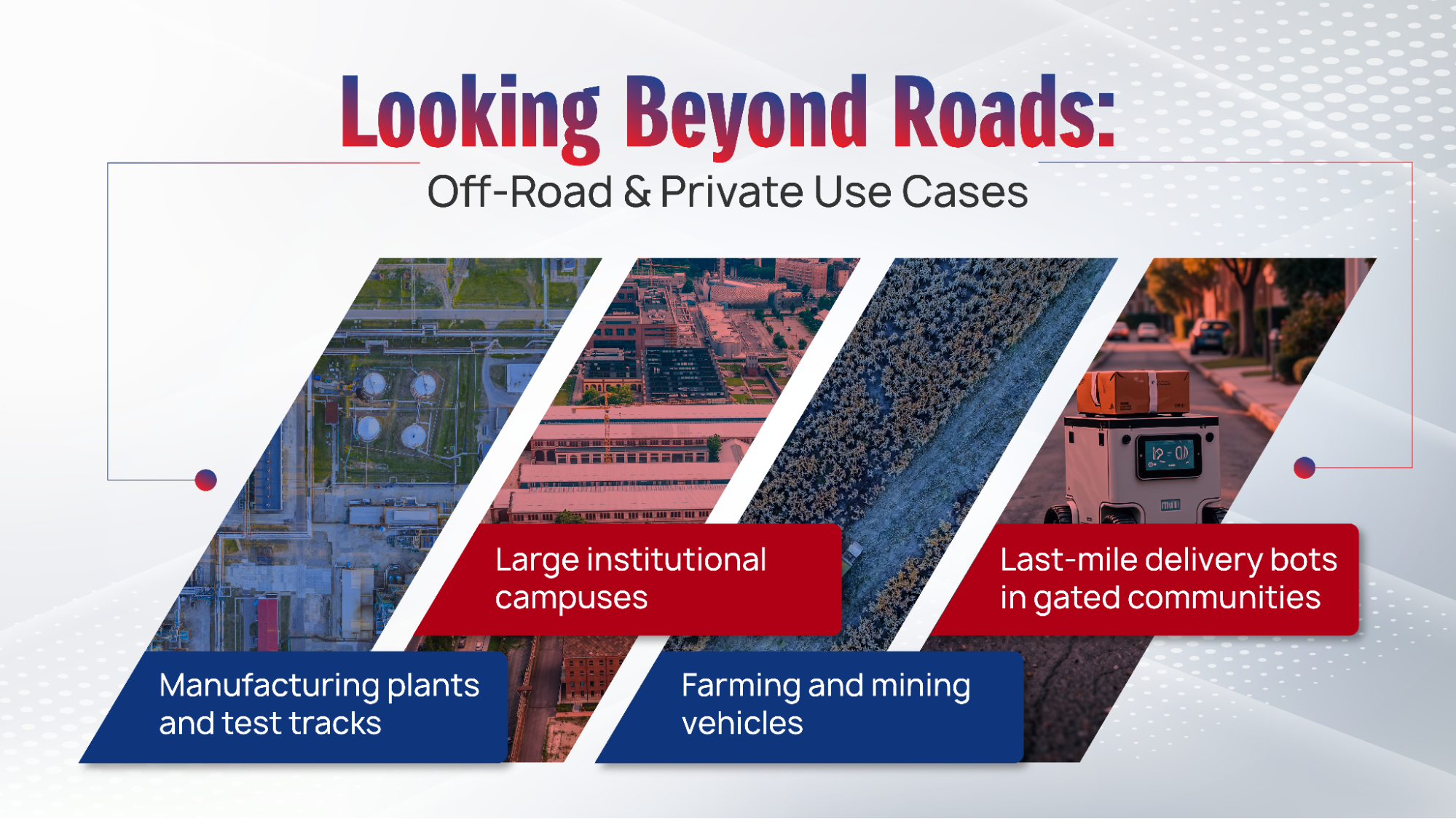
- Manufacturing plants and test tracks
- Large institutional campuses
- Farming and mining vehicles
- Last-mile delivery bots in gated communities
In these zones, where speed limits are low and rules can be standardised, autonomous systems can already demonstrate high value with minimal risk.
A Future Aligned With Electric and Connected Vehicles
Autonomy doesn’t work in isolation. It thrives at the intersection of electrification, connectivity, and cloud intelligence in electric and connected vehicles.
- EV range prediction models
- Battery health analytics
- Cloud-based software updates
- Vehicle-to-vehicle (V2V) and vehicle-to-infrastructure (V2I) communication
These form the digital backbone for tomorrow’s mobility platforms, connected, safe, and increasingly self-reliant. Together, they pave the way for smarter driving experiences tailored to the needs of Indian roads and users.
Conclusion: Leading the Future of Mobility
Urban India, with all its unpredictability, is the perfect lab for autonomous vehicles in India. The mix of challenges and tech progress creates the right setting for building better, smarter self-driving cars.
We are at the forefront, developing autonomous vehicle technology, improving urban mobility in India, and solving the challenges for autonomous vehicles in India through innovation and strong research.
As India continues to grow digitally and embrace clean mobility, smart mobility solutions like AVs will become more common. At Suzuki Research & Development India (SRDI), we are ensuring that we create not just products, but future-ready solutions.