
An Introduction to LiDAR for Autonomous Vehicles
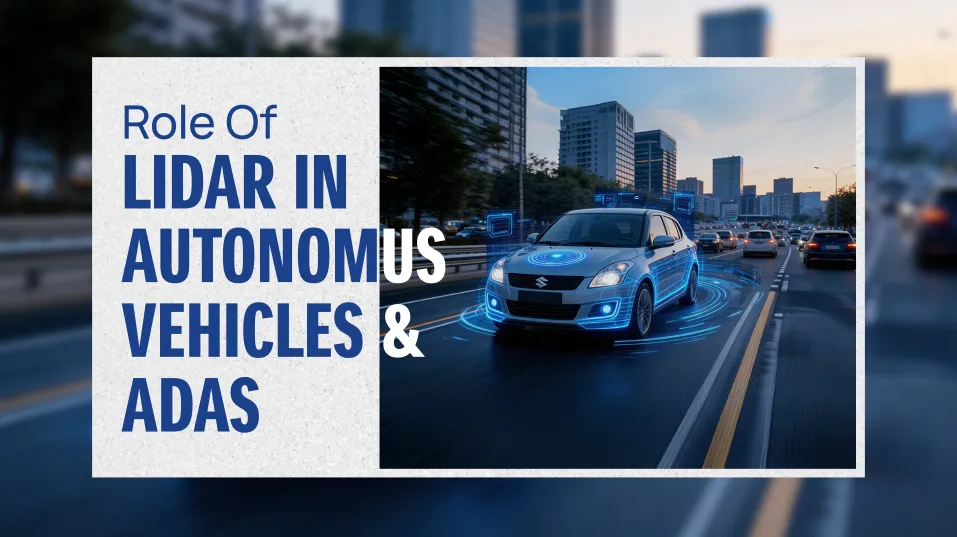
LiDAR, which stands for Light Detection and Ranging, is a vital sensor for autonomous vehicles. It emits laser pulses per second to cover a full 360-degree view & creates highly accurate 3D maps of the environment around the vehicle.
The data from these pulses (in the form of a point cloud) is processed in real time using advanced algorithms. It allows vehicles’ AI to detect & understand its surroundings for safe navigation, obstacle detection, and path planning. A self-driving LiDAR system has three main components:-
- A scanner
- A laser
- A GPS receiver.
This makes it a versatile tool for navigation, mapping, & safety in autonomous vehicles.
The data collected by lidar autonomous driving systems, known as point clouds, is processed to train AI that helps guide the car’s driving decisions.
Benefits of LiDAR Sensors in Autonomous Vehicles
- 3D Vision of Surroundings: LiDAR for automotive vehicles creates a clear 3D map of the surroundings. This helps the car recognise roads, pedestrians, obstacles, & traffic more accurately.
- Enhanced Safety: It spots pedestrians, other vehicles, & sudden obstacles, helping reduce the chance of accidents.
- Reliable Navigation: LiDAR automated driving cars make accurate decisions while turning, stopping, or changing lanes. It helps the vehicle accurately determine its position and location within a given area.
- Smooth Driving Experience: With real-time, accurate data, autonomous vehicles can drive more efficiently & comfortably.
- Environmental Perception: Best LiDR for autonomous vehicles provides a high-resolution 3D representation of the environment. For this, it complements other sensors like cameras & radar.
- Redundancy: LiDAR for cars serves as a crucial backup sensor. It ensures the vehicle can operate reliably even if other sensors malfunction.
- Performance in Challenging Conditions: Unlike cameras, self-driving LiDAR performs reliably in various lighting & weather conditions, including low light, shadows, and fog. =
How Does LiDAR Work in Autonomous Vehicles?
LiDAR for autonomous driving operates similarly to sonar but at much higher speeds. With Laser Pulse Emission, it sends out hundreds of thousands of laser pulses per second. This reflects off objects (like vehicles, trees, buildings, etc.) in the environment.
The Time-of-Flight (ToF) receiver measures the precise time it takes for each reflected laser pulse to return to the sensor. The system accurately calculates the distance to each object by multiplying the return time by the speed of light.
The distance to an object is calculated using this simple formula:-
Distance = Speed of light × Time of flight
2
An onboard computer collects these reflections to create a real-time 3D “point cloud” map of the surroundings.
A typical LiDAR for automotive systems has four main components:
- Transmitter – Emits laser pulses.
- Receiver – Captures reflected pulses.
- Optical System – Analyses the data.
- Computer – Creates a live, three-dimensional image of the environment.
Modern LiDAR autonomous cars use multiple laser emitters at the same time. This allows them to process millions of reflected points & give vehicles an extremely detailed understanding of their surroundings.
Autonomous vehicles use LiDAR sensors to “see” their surroundings. These sensors mainly come in two types:
1. Electro-Mechanical LiDAR
This is the traditional type of LiDAR. It has moving parts that spin to send out laser beams & scan the area around the car. Usually mounted on the roof, these sensors can cover long distances. They are accurate but tend to be heavy, expensive, & can wear out over time, especially on rough roads.
2. Solid-State LiDAR
Built on a single chip, lidar for autonomous vehicles integrates the laser emitter, receiver, and processor. These sensors are lightweight, cost-effective, & durable. They can be installed at the front, rear, or sides of a vehicle and are often less visible than traditional LiDAR.
Role in Autonomous Vehicles and ADAS
Beyond self-driving, LiDAR for automotive also plays a vital role in Advanced Driver Assistance Systems (ADAS) that are already available in many vehicles today.
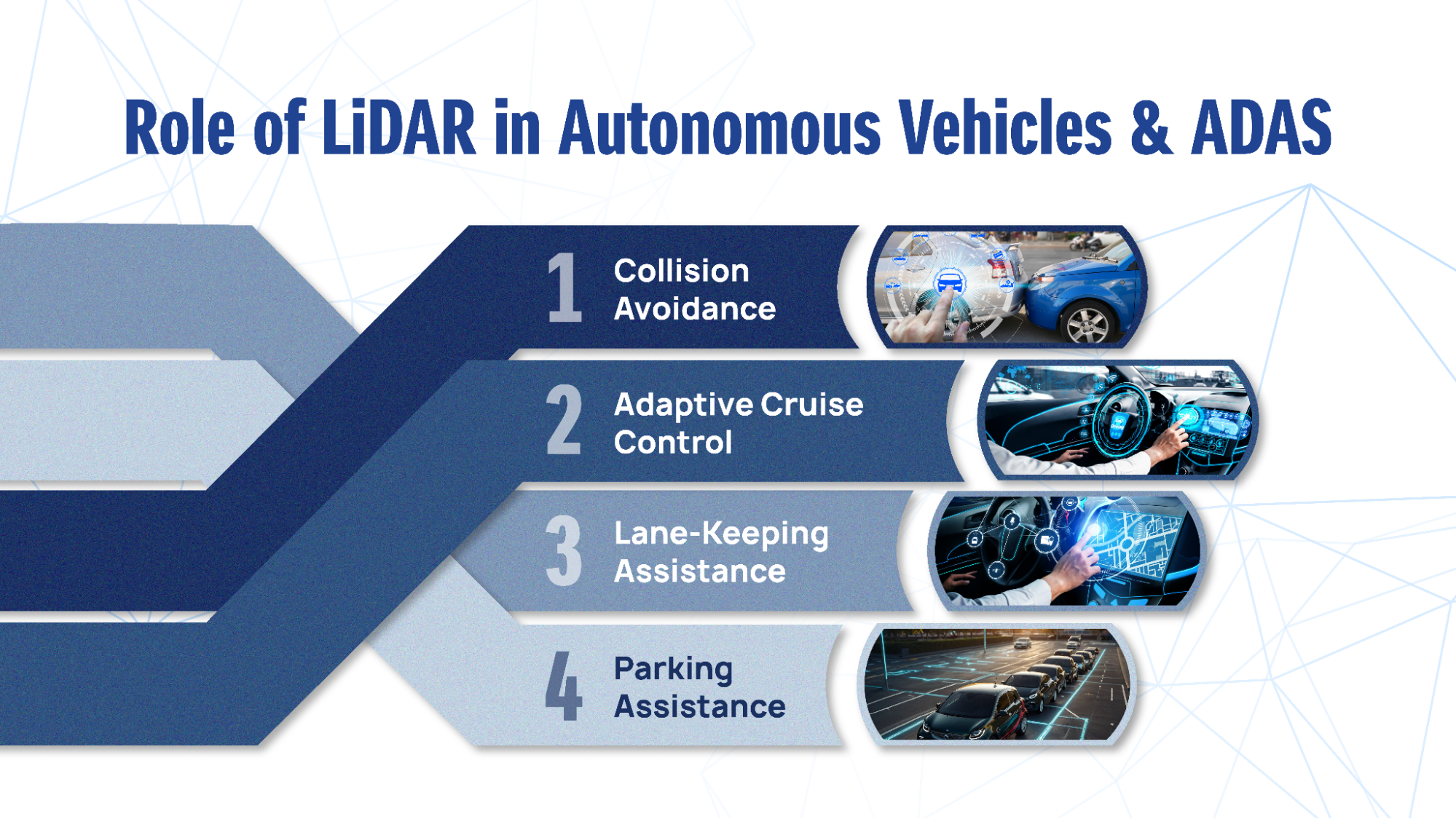
- Collision Avoidance: With real-time object detection, LiDAR autonomous cars can brake or steer to prevent accidents.
- Adaptive Cruise Control: Self-driving LiDAR allows vehicles to maintain safe distances by tracking nearby traffic with high accuracy.
- Lane-Keeping Assistance: LiDAR for cars maps road markings & boundaries. This helps the system keep the vehicle centred in its lane.
- Parking Assistance: LiDAR automated driving systems can guide vehicles into tight parking spots safely and smoothly.
Limitations of LiDAR Technology in Autonomous Vehicles
Even though LiDAR for cars offers many benefits for autonomous vehicles. However, it also has some limitations.
One major drawback is its high cost. This makes it less accessible for widespread use. Meanwhile, simpler & cheaper cameras, combined with radar, are improving quickly and can perform many of the same tasks as LiDAR.
However, LiDAR for automotive does have advantages over cameras:
- Handling sudden changes in light.
- Performing well in bad weather.
- Being less vulnerable to hacking.
But it can still struggle to understand complex, real-life situations. For example, a pedestrian distracted by their phone or a biker checking before changing lanes.
As AI-powered cameras improve, a combination of camera and radar could eventually replace LiDAR autonomous driving sensors in autonomous vehicles.
The Future of Automotive LiDAR with Suzuki R&D
LiDAR for cars is shaping the future of mobility. From helping with LiDAR autonomous driving to supporting today’s ADAS features, it is making vehicles safer, smarter, & more reliable.
While high costs and complex scenarios remain challenges, advances in solid-state designs are bringing us closer to affordable & practical solutions for everyday vehicles.
At Suzuki R&D, we believe LiDAR for automotive is a key technology for building the next generation of smart mobility. By combining self-driving LiDAR with AI & other sensors, we are working towards vehicles that can handle real-world conditions with confidence.