

Why Traction Control System Is Necessary in Modern Cars?
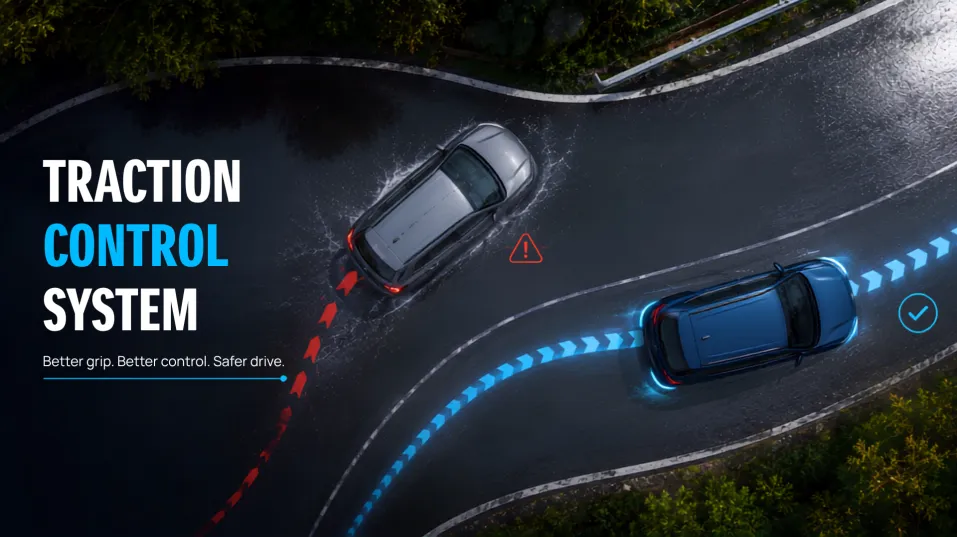
Traction Control System (TCS) is an active vehicle safety feature that prevents wheel spin during acceleration on slippery surfaces (wet, icy, gravel). It monitors wheel speeds & reduces engine torque or applies brakes to wheels that are losing traction. Working together with ABS & ESC, TCS helps maintain stability and keeps the vehicle on its intended path.
Why is it essential to have a Car Traction Control System?
Enhanced Stability & Safety
TCS prevents the car from skidding/ losing traction during cornering or sharp turns on wet or icy roads.
Automatic Intervention
It detects wheel spin faster than a driver can, automatically managing power & braking to keep the vehicle on its intended path.
Improved Handling
Prevents wheels from spinning out of control, & maintains proper grip. This results in a smoother, more secure driving experience.
Reduced Tyre Wear
The system reduces premature tyre wear.
Prevents Accidents
It reduces the likelihood of accidents on hazardous road surfaces.
Types of Car Traction Control Systems
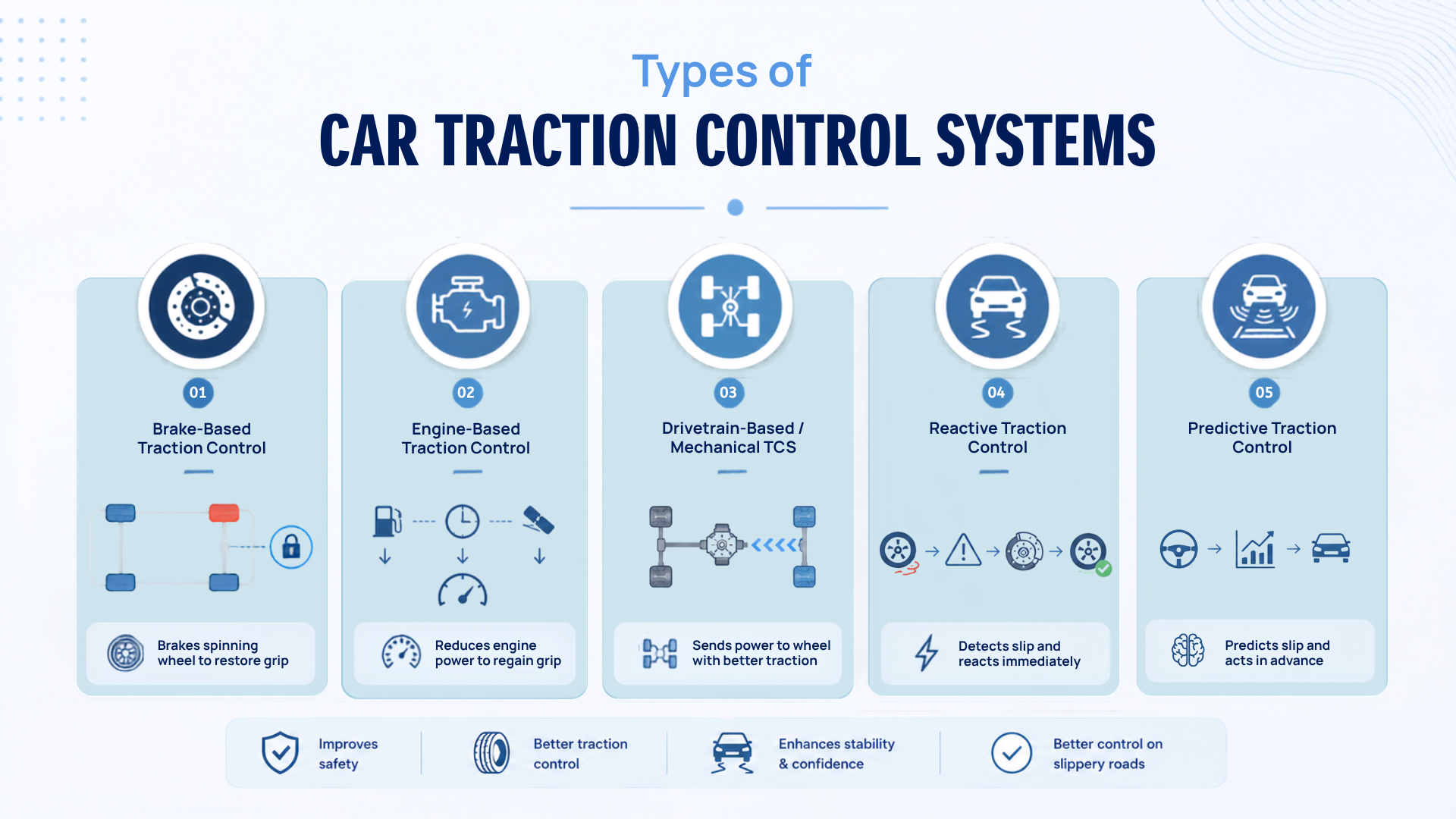
Brake-Based Automobile Traction Control System
This type of car traction system uses sensors from the anti-lock braking system. It monitors the wheel's speed.
If one wheel starts spinning faster than the others, it applies the brake to that wheel. Braking the spinning wheel helps it regain grip & allows power to transfer to the wheels with better traction.
Engine-Based Automobile Traction Control System
In this system, traction and stability control are managed by engine power. When wheel slip is detected, the engine control unit reduces power output. This may be done by:-
- Limiting fuel supply
- Adjusting ignition timing
- Reducing throttle input
Lower engine power helps the wheel regain grip on the road.
Drivetrain-Based/ Mechanical Automobile Traction Control System
This active traction control uses a mechanical component called a limited-slip differential. It controls how power is shared between the wheels on the same axle.
If one wheel loses grip, more power is sent to the wheel with better traction. It is commonly found in older vehicles & some high-performance cars.
Reactive Automobile Traction Control System
Reactive traction control responds after the wheel spin has already started. The TCS Traction Control system detects the loss of grip & then intervenes immediately using braking or engine power reduction.
Most cars with traction control on Indian roads use this type of system.
Predictive Automobile Traction Control System
Predictive traction control is a more advanced system. It is the best traction control system that analyses vehicle data such as steering input, speed, & vehicle movement & estimate when traction loss may occur.
These type of cars with a traction control system acts in advance & reduce the chance of wheel spin. It is usually found in premium or advanced vehicles.
Operating Modes of the Car Traction Control System
Standalone Traction Control in a Car
This automatic traction control system is designed only to prevent wheel spin during acceleration. It monitors wheel grip & steps in when a wheel starts spinning too fast.
The car's traction control system maintains grip & helps the vehicle move forward safely on slippery or uneven roads.
Electronic Stability Control
Electronic Stability Control is a more advanced safety system, which includes TCS. It monitors how the car is steering & moving.
If the car starts skidding or losing direction, the system applies brakes to individual wheels & reduces engine power to help the driver keep the car under control.
Features of Traction Control Systems
- Prevents Excessive Wheel Spin: Detects if drive wheels are spinning faster than the vehicle's actual speed & reduces torque to regain grip.
- Active Brake Intervention: Applies braking force individually to a slipping wheel, allowing torque to transfer to wheels with better traction.
- Engine Power Management: Temporarily reduces engine power by controlling throttle input, spark sequence, or fuel supply to stop wheel spin.
- Enhanced Vehicle Stability: Operates with other safety systems to maintain stability in corners & during sudden acceleration.
Components of a Car Traction Control System
Wheel Speed Sensors
Each wheel is equipped with a sensor in the automatic traction control system of the car. It measures the rotational speed & gives real-time data to the control unit.
Electronic Control Unit
The control unit processes the sensor data & determines when intervention is required. It acts as the decision-making centre of the system.
Hydraulic Modulator/Actuator
Uses solenoid valves to apply brake pressure independently to the slipping wheel, stopping it from spinning.
Throttle control (Engine Management System)
In vehicles with electronic throttle control, the automatic traction control system can reduce engine output to prevent further wheel spin.
ABS System Integration
TCS shares the hydraulic unit & sensors with the Anti-lock Braking System (ABS).
Indicator Light on Dashboard
A warning light alerts the driver regarding the system engagement & malfunctions.
How Car Traction Control System work?
- The wheel speed sensors constantly send data to the Electronic Control Unit (ECU). It regularly monitors if one tyre is spinning faster than the others.
- When a wheel starts to lose traction & spins faster than the vehicle's speed allows, the TCS identifies this as a loss of control.
- The system automatically takes one or both of the following actions to restore grip: -
- Brake Intervention: The hydraulic modulator applies the brakes to the specific spinning wheel to slow it down.
- Engine Power Reduction: The ECU reduces engine power & throttles back. It reduces fuel to the cylinders or delays spark timing.
- By reducing power & slowing the spinning wheel, torque is transferred back to the tyres with grip, restoring stability.
Relationship Between Car Traction Control & Other Safety Systems
Traction control in a car does not operate in isolation. It shares components and data with:
- Anti-lock braking systems
- Electronic stability control
- Brake force distribution systems
While anti-lock braking prevents wheel lock during braking, traction control manages wheel spin during acceleration. Electronic stability control goes further by managing vehicle direction during cornering & sudden manoeuvres.
Together, these cars with traction control form a coordinated safety architecture.
Traction Control Indicator Light Meaning
Flashing indicator
A flashing light of the automatic traction control system indicates that the system is actively intervening. This is normal during low-traction conditions.
Constantly illuminated indicator
A steady light usually indicates a system fault. This may involve sensor failure, wiring issues, or related braking system problems.
Indicator with “OFF” symbol
This indicates that traction control has been manually disabled by the driver.
Drivers should not ignore persistent warning lights & should have the system inspected if the light remains on during normal driving.
Car Traction System: Activation and Deactivation
When Does Traction Control Activate?
Cars with traction control activate automatically when the system detects conditions that can cause wheel spin. Common activation scenarios include:
- Accelerating on wet or slippery roads
- Starting from a standstill on loose surfaces
- Sharp acceleration inputs
- Uneven road grip between wheels
- Mild cornering under low traction
When Traction Control Should Be Turned Off?
Although traction control in a car improves safety in most situations, there are specific scenarios where disabling it may be helpful. These include:
- Vehicle stuck in deep mud or snow
- Driving through loose sand
- Attempting to rock the vehicle free
- Climbing steep, slippery inclines at low speed
In such cases, limited wheel spin can help build momentum. Traction control may reduce engine power and make recovery difficult.
Please Note:-
Disabling the TCS should be done temporarily & only when required.
Limitations of Car Traction Control Systems
It cannot create traction
TCS Traction Control cannot increase grip beyond what tyres & road conditions allow. It only manages available traction.
Reduced engine response
During intervention, engine power may feel reduced. This is a controlled limitation, not a malfunction.
Sensor dependency
The system relies heavily on sensors. Faulty sensors can cause incorrect intervention or system deactivation.
Not a substitute for safe driving
Traction control assists the driver but does not eliminate the need for controlled driving behaviour.
Car Traction System in Indian Driving Conditions
Indian roads present diverse challenges, from smooth highways to rough and uneven terrain. To address these conditions, Suzuki R&D India is exploring advanced traction and stability systems that could improve grip and vehicle control in the future.
Maintenance and Car Traction System Health
Traction control requires minimal maintenance but depends on the overall vehicle condition. Key factors affecting system performance include:
- Tyre condition and pressure
- Wheel alignment
- Brake system health
- Clean and functional sensors
- Regular servicing helps ensure reliable operation.