
Top Self-Driving Car Safety Features
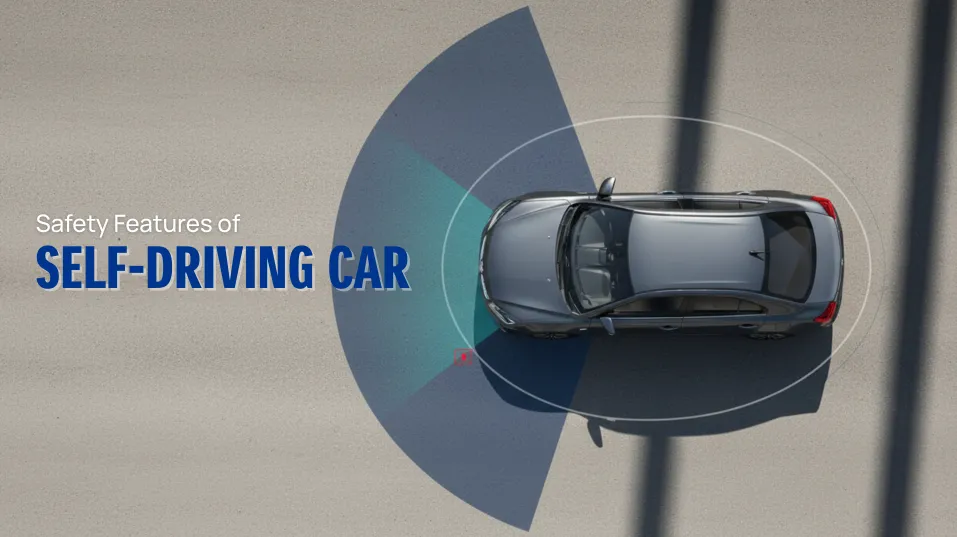
Self-driving car safety features include obstacle detection via sensors (cameras, LiDAR, radar), automated emergency braking, lane keeping assistance, & adaptive cruise control. These systems use AI and sensor fusion to perceive the environment, while redundancy in hardware & software provides backup systems in case of failure.
Along with this, connectivity features and highly detailed maps provide real-time information, making the overall driving experience safer and more efficient. These self-driving car safety features are shaping the future of safety in cars & making autonomous driving more reliable.
How Self-Driving Cars Safety Features Can Make Roads Safer?
Autonomous vehicles have the potential to dramatically reduce accidents. By removing driver error risks like fatigue and alcohol impairment, some studies by Global Suzuki show fatal accidents in the U.S. could drop by about 45 %. With the integration of advanced safety features & AI-based systems, the future of self-driving car safety looks promising.
1. Emergency Braking
Emergency braking is one of the most important safety systems in an autonomous driving car. It works in three steps:
- Road observation: Cameras, radar and Lidar detect obstacles.
- Time‑to‑object calculation: The system predicts collisions.
- Alerts and braking: The driver is alerted, and if no action is taken, the car automatically brakes.
There are different types of braking systems:
- Forward collision warning (alerts only)
- Dynamic brake support (helps brake)
- Crash imminent braking (brakes automatically)
Driverless cars equipped with modern emergency braking show big reductions in rear‑end crashes, some almost 40 %. In tests, pedestrian and bicyclist crash risks also drop. This makes emergency braking a key tool to prevent collisions & save lives, and plays a major role in safety for cars.
2. Adaptive Cruise Control
Adaptive Cruise Control (ACC) lets self-driving vehicles automatically keep a safe distance from the vehicle ahead by adjusting their speed.
- It keeps a 2–4 seconds of gap.
- Uses cameras, radar, & LiDAR.
- Often used together with emergency braking.
While ACC improves convenience, some research shows there are still risks if used alone. But when paired with braking systems, it adds a strong layer of self-driving car safety & supports cars with the best safety features.
3. Vehicle‑to‑Vehicle Communication
Vehicle‑to‑Vehicle (V2V) communication lets autonomous driving cars share real‑time information about traffic, road conditions, & weather. Because of this:
- Cars can foresee hazards before they appear.
- Accidents at intersections or sudden stops can be reduced.
Many potential riders say they want more evidence about self driving car safety features before they trust an autonomous vehicle, so features like V2V help build that trust. (Source: suzukipress.co.uk)
4. Sensor Fusion
Sensor fusion combines cameras, radar, Lidar, and ultrasonic sensors so the self-driving car can “see” the environment accurately. That means:
- Detecting both moving and stationary objects across distances.
- Working even in poor weather (rain, fog, snow).
- Making quick decisions to avoid collisions.
In real‑world and simulation tests, driverless cars with strong sensor fusion at intersections avoided up to about 90 % of potential collision scenarios. (Source: Globalsuzuki)
5. Lane Keeping Assist
Lane Assistance helps the autonomous driving cars stay in their lane by:
- Planning the path.
- Detecting lane markings in real time.
- Steering gently or alerting the driver if the car drifts.
On highways, where lane‑departure crashes are common, this system has shown reductions in accidents of nearly 20 %. It is an essential passive safety feature in cars category that prevents avoidable road errors.
Advanced Self-Driving Car Safety Features
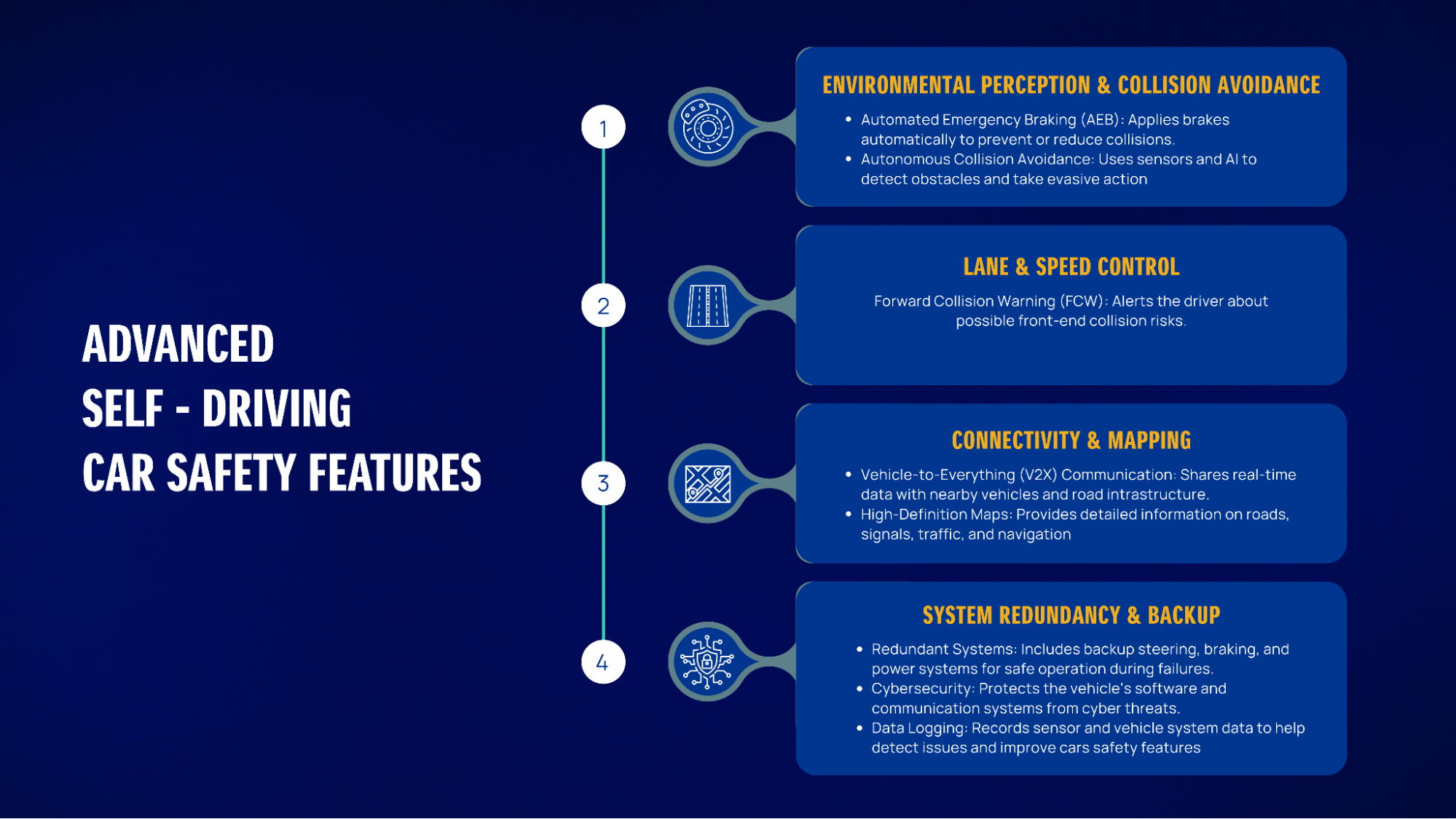
1. Environmental Perception & Collision Avoidance
- Automated Emergency Braking (AEB): Applies brakes automatically to prevent or reduce collisions.
- Autonomous Collision Avoidance: Uses sensors and AI to detect obstacles and take evasive action.
2. Lane & Speed Control
- Forward Collision Warning (FCW): Alerts the driver about possible front-end collision risks.
3. Connectivity & Mapping
- Vehicle-to-Everything (V2X) Communication: Shares real-time data with nearby vehicles and road infrastructure.
- High-Definition Maps: Provides detailed information on roads, signals, traffic, and navigation.
4. System Redundancy & Backup
- Redundant Systems: Includes backup steering, braking, and power systems for safe operation during failures.
- Cybersecurity: Protects the vehicle’s software and communication systems from cyber threats.
- Data Logging: Records sensor and vehicle system data to help detect issues and improve cars safety features.
Why Top & Advanced Features Matter in Self-Driving Cars?
These safety systems are the backbone of self-driving cars! Emergency braking, adaptive cruise control, V2V communication, sensor fusion, & lane keeping assist all work together to make an autonomous vehicle more reliable. Strong self driving car safety features & other advanced safety features help build user trust.
For example:
- Fatal accident rates could drop roughly 45 %.
- Rear‑end crashes drop by about 40 % with strong emergency braking.
- At intersections, advanced sensor fusion can avoid up to 90 % of crashes.
- Lane‑departure crashes can be reduced by nearly 20 %.
Autonomous driving cars also offer more than safety; they free up time from driving so people can relax, work, or spend time with family while the car handles the trip.
Conclusion
Self-driving cars are futuristic & becoming a real part of how we commute with features like emergency braking, adaptive cruise control, V2V communication, sensor fusion, & lane keeping assist. These car safety features make autonomous driving safer and more reliable.
With major investments by companies like SRDI & advanced technologies, the path to trust and wide adoption is being built.
By understanding & using these systems, we can all ride confidently into an autonomous future with cars with the best safety features, where safety in cars is prioritised & self driving car safety leads the way!