
Vehicle Dynamic Control Explained: Features, Benefits, and Technology
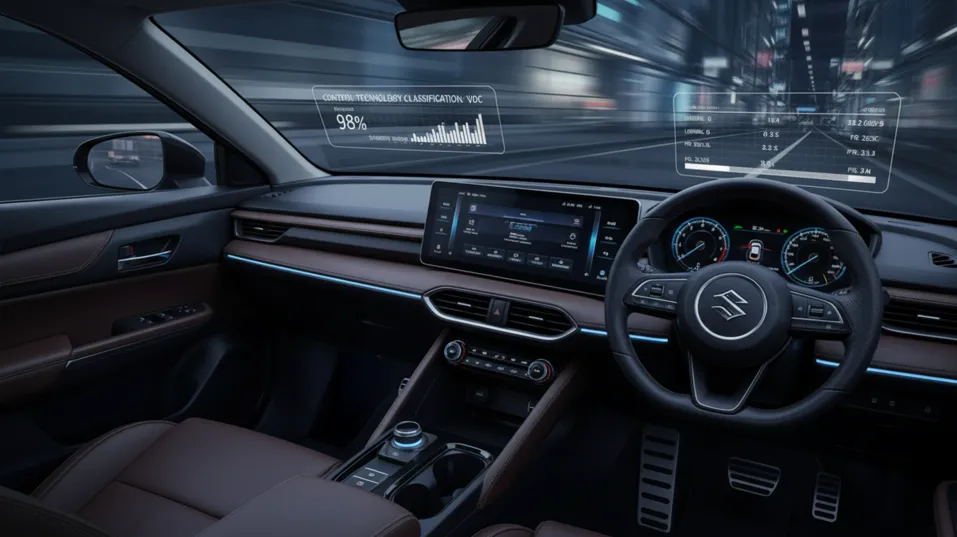
Vehicle Dynamic Control (VDC) is a type of Electronic Stability Control (ESC). It is also termed as ESP. It employs sensors to monitor the speed of the wheel, steering, yaw rate, & lateral accelerations. This detects oversteering, understeering, and impending skids.
If the vehicle starts to lose control, the Vehicle Dynamics Control (VDC) system steps in by braking individual wheels or reducing engine power. This keeps the vehicle stable, prevents skidding, & helps keep everyone inside safe.
Features of Vehicle Dynamic Control
Sensor Network
Vehicle Dynamic Control relies on various types of sensors. This includes lateral acceleration sensors, yaw rate sensors, wheel speed sensors, & steering wheel angle sensors.
Real Time Monitoring
It regularly compares the steering input of the driver to the actual direction of the vehicle and other dynamic factors.
Invervention Capabilities
The vehicle dynamic control system can automatically detect the deviation of the vehicle. Hence, can:-
- Reduce fuel flow to the engine
- Reduce torque
- Apply braking force to the individual wheels
- Adjust the torque split in all-wheel-drive systems
Integration with Other Systems
Vehicle Dynamic Control can leverage the existing system, such as Traction Control Systems & Anti-Lock Braking Systems.
Benefits of Vehicle Dynamics Control
- Enhanced Safety: Helps keep the vehicle stable & under control during sudden maneuvers, sharp turns, slippery roads, or automated speed adjustments using dynamic cruise control.
- Increased Driver Confidence: Makes drivers feel more confident about handling the vehicle, even in challenging conditions. Cars with dynamic cruise control respond better to varying road situations.
- Works with Other Systems: VDC integrates seamlessly with systems like traction control, ABS, & dynamic cruise control to provide a complete safety network.
Types of Vehicle Dynamics Control
The vehicle dynamic control system employs actuators, sensors, & software to improve & manage the vehicle’s movement in vertical, lateral, & longitudinal directions. These systems are categorised in many ways:-
Classification as per the direction of motion
Vehicle Dynamic Control Systems are mainly designed to control the movement of vehicles along three axes:-
Longitudinal Control
It manages the backward & forward movement of the vehicle through braking and acceleration.
- Anti Lock Braking System: This vehicle dynamic control system prevents the lockup of the wheel while braking hard. Hence, allows the driver to maintain control of steering.
- Traction Control System: It limits & detects the wheel spin to ensure effective steering & acceleration, particularly on slippery surfaces.
- Adaptive Cruise Control: Adaptive cruise control, also referred to as Dynamic Cruise Control in some vehicles, controls the speed of the vehicle automatically & maintains a safe distance from the vehicle ahead.
- Hill Start Assistance: This system engages the brake for a few moments when starting to incline & prevents the vehicle from rolling backwards.
Lateral Control
Manages the side-to-side movement of the vehicle that is critical for cornering and steering.
- Electronic Stability Program (ESP)/ Electronic Stability Control (ESC): It automatically applies the brakes to individual wheels & helps steer the vehicle in the intended direction when oversteer (fishtailing) or understeer (plowing) is detected.
- Active Four-Wheel Steering (4WS): This vehicle dynamics control system allows the real wheels to turn. It can be in either direction (same or opposite) to the front of the wheels to improve high-speed stability & low-speed manoeuvrability.
- Torque Vectoring: Torque vectoring distributes drive torques between the wheels on an axle. It sends more power to the outside wheel while turning to improve handling & traction.
Vertical Control
Manages the up-and-down movement of the vehicle & body vibrations, which is vital for safety & comfort.
- Active Suspension Systems: ASS employs a computer-controlled actuator to counteract the movements of the vehicle, such as roll & pitch. It offers handling & superior comfort.
- Semi-Active Suspension Systems: They adjust to the damping force of shocks automatically based on sensor readings, providing a better balance between ride comfort & handling.
- Active Body Control: ABC controls the movement of the body via hydraulically-controlled suspension struts.
Classification by Control Technology
VDC can also be classified based on how advanced the control methods are:
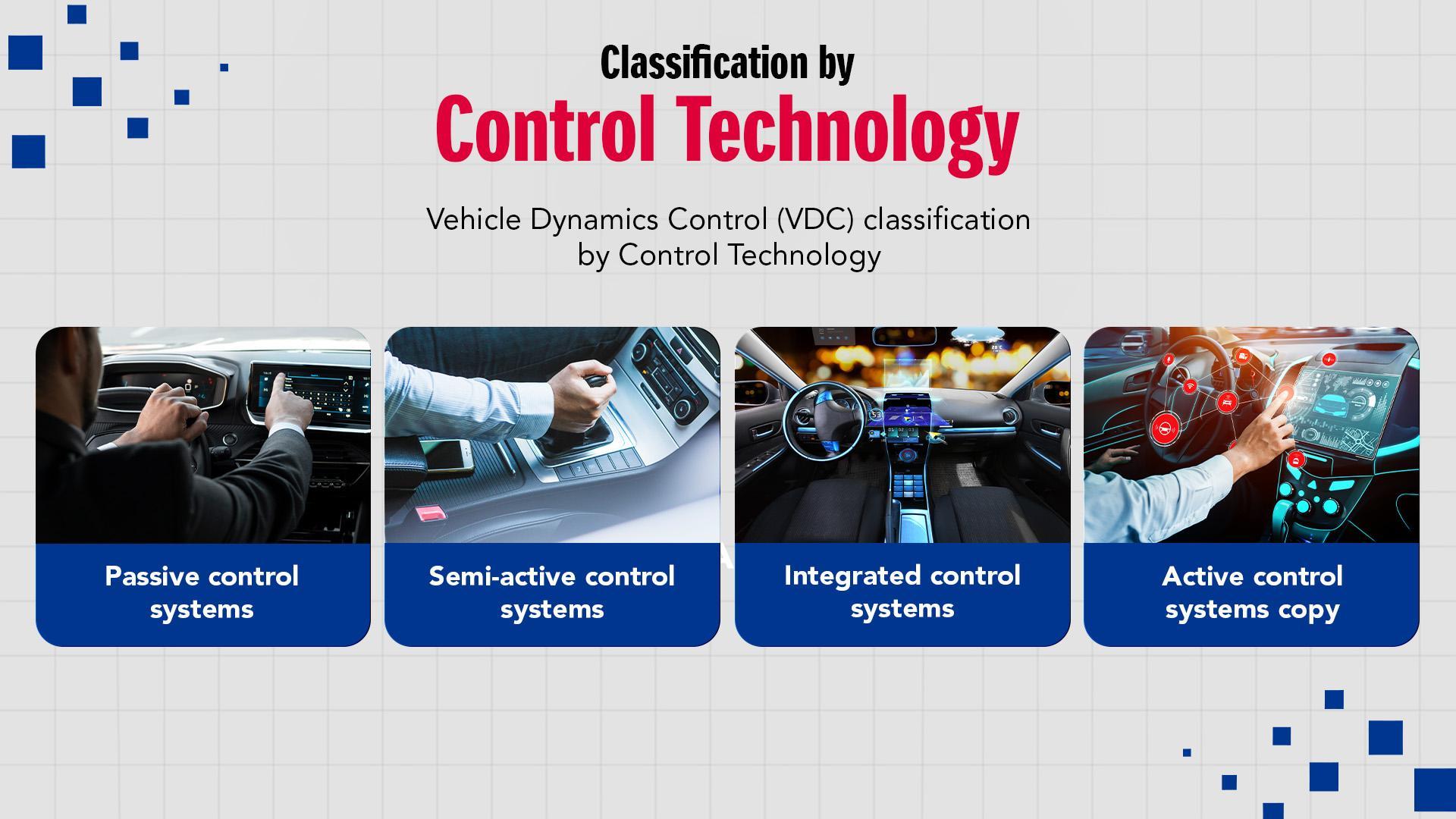
- Passive control systems: These use only mechanical components without any active adjustments. Examples include traditional springs, shock absorbers, & anti-roll bars.
- Semi-active control systems: These are a mix of passive & active systems. They use variable-damping technology to adjust automatically to road and driving conditions, but they do not add extra energy to the system.
- Active control systems: These types of vehicle dynamic systems make real-time adjustments continuously & can add or remove energy using actuators. They are more advanced and responsive systems.
- Integrated control systems: These systems coordinate multiple vehicle controls, like brakes, suspension, & steering, to work seamlessly together. This improves vehicle performance while providing a higher level of safety & comfort.
How does Vehicle Dynamics Control Work?
Sensors monitor vehicle movement
Vehicle Dynamic Control uses sensors like wheel speed sensors, steering angle sensors, lateral accelerator sensor, & yaw rate sensors to track the motion of the vehicle.
Driver inputs are measured
The system also monitors the input of the driver. This includes accelerator pedal position & steering wheel movement. This will help to understand the intended direction of the vehicle.
Compare intended vs. actual path
The VDC control unit continuously checks if the car is following the path the driver wants.
Intervention when needed
- Understeering: If the actual path of the vehicle is turning less than intended, VDC will reduce power. It will also brake the inside real wheel of the vehicle to follow the turn.
- Oversteering: If the actual path of the vehicle is narrower than intended, the system reduces the engine torque. It also applies the brake to the outside front wheel to stabilise the vehicle.
- Skidding/ Wheel Spin: The system corrects skidding by adjusting motor/ engine output & applying braking force to individual wheels. This prevents the vehicle from losing traction or slipping.
Seamless operation
VDC works smoothly & subtly, helping the driver stay in control without them even noticing the intervention.
Tools and Technology of Vehicle Dynamics Control
| Category | Technology / Feature | Description |
| Advanced Control Systems | Electronic Stability Control (ESC) | Uses sensors to detect wheel slippage. Applies brakes to individual wheels & reduces engine power to correct oversteer or understeer. It will keep the vehicle stable. |
| Traction Control System (TCS) | Limits wheel spin during acceleration on slippery surfaces to ensure maximum traction. Some systems (e.g., Brake-LSD) redirect power to wheels with more grip. | |
| Active Suspension Systems | Uses actuators to manage wheel movement & adjust to road conditions. Improves ride comfort and handling simultaneously. | |
| Active Front Steering (AFS) & Rear-Axle Steering | Adjusts steering angles to enhance maneuverability, stability at high speeds, & agility at low speeds. | |
| Regenerative Braking | Recovers kinetic energy during deceleration, reduces brake wear, & allows precise braking when integrated with electronic systems. | |
| Torque Vectoring | Distributes torque individually to each wheel for faster & precise control over vehicle yaw and lateral dynamics. | |
| Simulation & Modeling | Multi-Body Systems (MBS) Simulation | Models all vehicle components (chassis, tires, suspension) for virtual validation under real-world conditions. |
| Hardware-in-the-Loop (HIL) Testing | Connects physical components to a real-time vehicle simulation for safe, repeatable performance testing of ECUs & hardware. | |
| Digital Twins | Creates a virtual replica of the vehicle & environment for testing dynamics and autonomous features before physical testing. | |
| Emerging / Future Technologies | AI & Machine Learning | Predicts driver intent & road conditions; optimises dynamic parameters and trains autonomous vehicles for advanced maneuvers. |
| Connected Vehicle Systems (V2X) | Enables communication between vehicles, infrastructure, & pedestrians to improve safety and smooth driving. | |
| Human-Centric Design | Uses AI to adapt driving to passenger comfort & provide feedback to keep drivers engaged. | |
| Software-Defined Vehicles | Vehicle operations like braking & steering are managed by software with over-the-air updates for improved performance. |
Driving Innovation with SRDI
At SRDI (Suzuki Research & Development India), the team is continuously conducting research & experiments to develop and refine Vehicle Dynamic Control (VDC) systems.
By working on advanced sensors, software, & actuators, we are ensuring that our vehicles remain stable, responsive, and safe in all driving conditions.
Using state-of-the-art tools like multi-body simulations, hardware-in-the-loop testing, & digital twins, we are optimising VDC systems for precise control during oversteer, understeer, & skidding scenarios. We are also exploring future-ready enhancements, including AI-based predictive control, connected vehicle technologies (V2X), & software-defined vehicle systems.